Disclaimer: The appearance of third-party products or services does not imply or constitute Department of War or U.S. Army endorsement. The intent of the essay is to encourage professional discourse. The views, opinions, and analysis expressed do not represent the U.S. Army or the Department of War.
Introduction
Mobile, secure, and scalable mesh network technology significantly increases U.S. Army special operations forces’ (ARSOF) communications flexibility, operational security, resilience, and survivability during high-risk missions in hostile, denied, or contested operational environments. The purpose of this article is to explore an innovative tactical communications capability that can help inform the Army Transformation Initiative and enable “the ARSOF Advantage” five lines of effort by providing “ARSOF in Contact” with secure, off-grid mesh network technology.
01 Contested or degraded operational environments require next-generation processes and capabilities that provide resiliency, interoperability, security, and agility for ARSOF teams navigating the contemporary competition-crisis-conflict continuum.
02 For example, Special Forces Operational Detachment-Alphas (SFOD-As) routinely employ technical collection and communications equipment, such as the Remote Advise and Assist Virtual Accompany Kit (RAA/VAK) to support partner force operations forward of friendly lines.
03 Most recently, U.S. special operations forces (SOF) and British SOF have conducted remote, advise, and assist operations and provided RAA/VAK-enabled over-the-horizon support to Ukrainian partners during large-scale combat operations (LSCO) against Russia.
04 The problem is that the current RAA/VAK configuration lacks a cost-effective mesh network component that allows ARSOF to maintain near real-time situational awareness, communications (texting), and tracking of partner force operations in austere conditions. As modern warfare increasingly relies on unmanned or machine-based systems and decentralized communication, integrating a low-cost, low-footprint, and secure mesh network radio component, such as the goTenna Pro X2, into the current RAA/VAK directly enhances ARSOF’s future relative advantages executing the five ARSOF lines of effort in support of joint force offensive and defensive combat operations.
Operational Context: ARSOF in Contact
The U.S. Army implemented a comprehensive transformation strategy in April 2025. The Army Transformation Initiative charged all leaders to reexamine standing requirements to eliminate obsolescence and make the force leaner, more lethal, and more adaptable for fighting future wars. The lines of effort for the Army Transformation Initiative include:
- Deliver critical warfighting capabilities.
- Optimize our force structure.
- Eliminate waste and obsolete programs.
The Army Transformation Initiative builds upon the concept of transformation in contact that encourages the rapid integration of new technologies and capabilities at the end-user level. The transformation in contact initiative allows soldiers to innovate, experiment, and make changes in real time.
05 ARSOF “in Contact” helps inform the ongoing Army Transformation Initiative through the delivery of critical SOF warfighting capabilities and the integration of new technology that generates an “ARSOF Advantage.”
ARSOF policymakers recently identified five lines of effort imperative to creating an “ARSOF Advantage,” or value proposition, to the joint force for how ARSOF can drive a transformational mindset and achieve strategic effects against peer adversaries during large-scale combat operations. The lines of effort include:
- Conduct deep and denied area sensing.
- Counter-C5ISRT (Command, Control, Communications, Computers, Cyber, Intelligence, Surveillance, Reconnaissance, and Targeting).
- Conduct deep area partner force maneuver.
- PSYWAR (Psychological Warfare).
- Enhance resilience, develop resistance forces, consolidate gains.
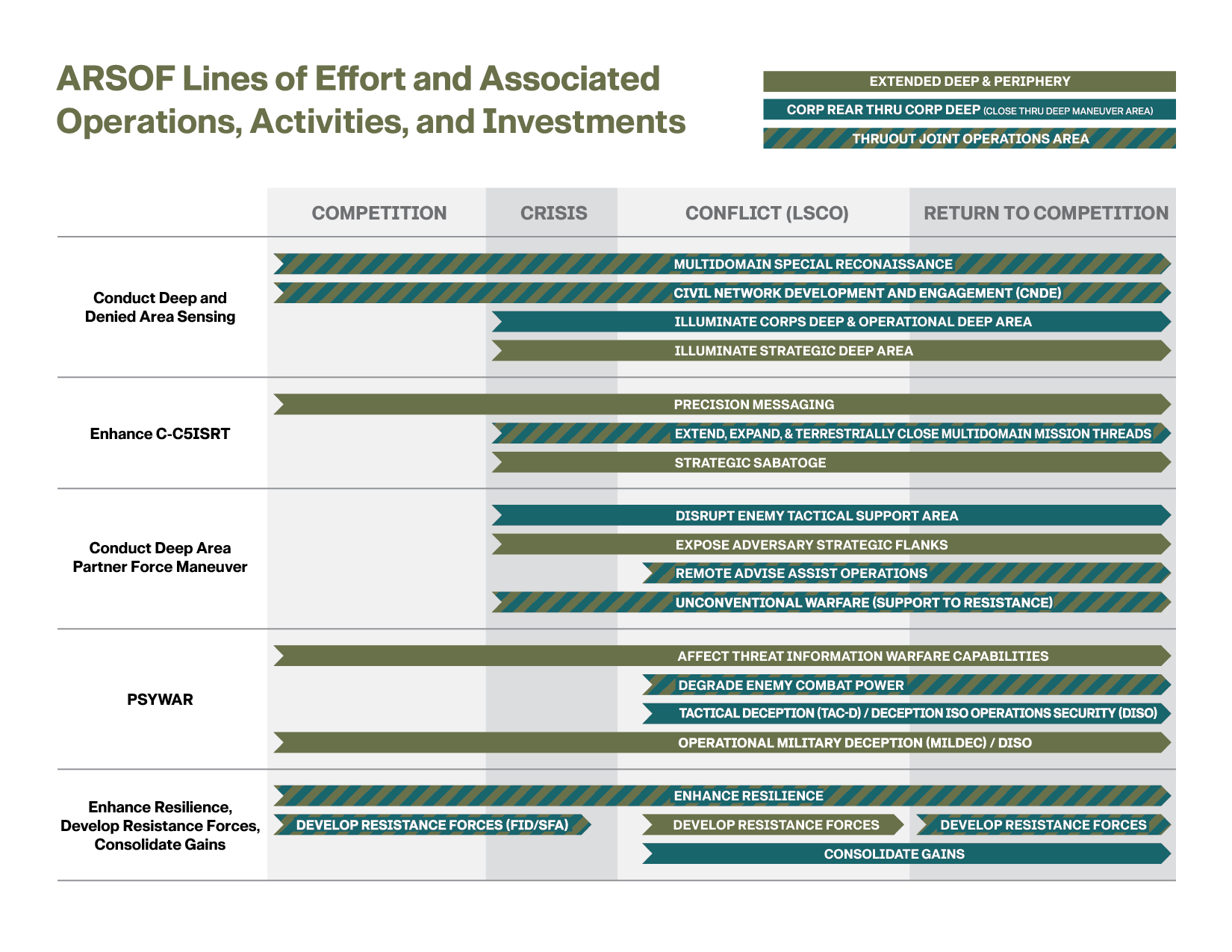
Figure 1. ARSOF Lines of Effort and Associated Operations, Activities, and Investments from 1st Special Forces Command (SFC) G5, “How ARSOF Fights,” 2025.06
Integrating a secure mesh network radio component into the current RAA/VAK boosts ARSOF’s ability to execute these lines of effort and their associated operations, activities, and investments (See Figure 1). This technology better enables ARSOF to maintain connectivity during multi-domain operations and integrate the autonomous systems, unmanned platforms, and machines used by partner force conducting SOF-enabled missions in deep areas typically denied by enemy C5ISRT systems. Though the RAA/VAK has evolved and improved over time, the addition of this technology has the potential to transform ARSOF capabilities to support the new operational concept of “ARSOF in Contact.”
07
RAA/VAK Evolution and Wireless Mesh Networks
In June 2014, U.S. national policy restricted SOF operators in Iraq from accompanying partner forces in combat against the Islamic State of Iraq and the Levant (ISIL). In response, SOF reverted to an advisor role, employing a remote, advise, and assist operations concept to work with and through partner force. They leveraged ad-hoc cellular networks, Android devices, beyond line-of-sight communications, and other software to provide remote support. These early RAA/VAKs proved highly effective in enabling operations, despite some initial design limitations. The RAA/VAKs continued to develop and evolve throughout the Global War on Terror era and stand to benefit from upgraded equipment to meet the modern operational environment.
08 The modern versions of the kit (See Figure 2) are designed to provide a suite of tools for mission planning and execution, command and control of partner forces, and access to real-time data to improve situational awareness and de-conflict operations.
09 Integration of mesh networking radios into the RAA/VAKs can directly enhance the asset’s utility across the full spectrum of special operations.
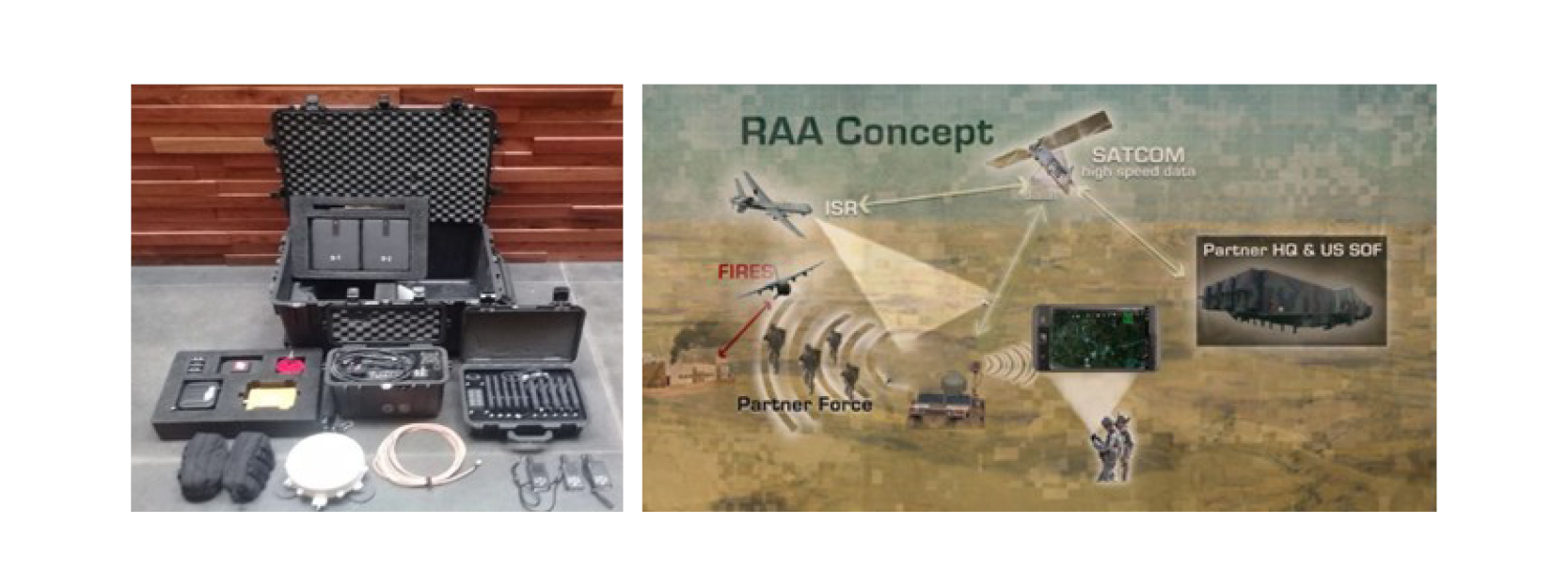
Figure 2. Historical Remote Advise and Assist Virtual Accompany Kit (RAA/VAK) and Remote Advise and Assist (RAA) Concept from SOF AT&L TCC Brief. (Note: Photos/Contents of most current operational kits omitted due to operational security. More detailed history of the program between 2017 and 2025 considered to be controlled information).10
Wireless mesh networks are not a new idea.
11 Modern wireless mesh networks trace their origins to extensive U.S. military research and development.
12 They enable direct device-to-device communication without relying on centralized infrastructure. These decentralized systems route data through multiple “hops” and have evolved under various names and uses over the past several decades. Their flexibility allows nodes to remain stationary or mobile, supporting operations in austere environments where conventional networks fail.
13 The addition of mobile or wireless mesh networks closes various identified RAA/VAK capability gaps by providing secure, low-signature, and infrastructure-independent communications and tracking.
Current RAA/VAK Capability Gaps
ARSOF has employed the RAA/VAK in numerous conflict zones over the last decade. This asset has assisted SFOD-As in capturing and transferring near-real-time data, providing battlefield situational awareness through the remote training and monitoring of partner forces.
14 Despite the clear operational value of the RAA/VAK, numerous capability gaps remain unaddressed. The current system still only provides limited secure communications with partner forces, carrying with it an inherent risk of compromised sensitive communications during battlefield use. The kit also does not contain a low-SWaP-C (size, weight, power consumption, and cost), non-infrastructure-based alternative for line-of-sight communication.
15
Notably, the current kit lacks a near-real-time tracking solution for military free-fall parachute infiltrations.
16 Contemporary ARSOF partners increasingly train on high-altitude high-opening (HAHO) and high-altitude low-opening (HALO) free-fall operations to maintain interoperability and better integrate tactics and approaches to problem-solving in unconventional warfare.
17 The kit also has inadequate signal detection mitigation measures and lacks integrated radio frequency awareness tools for spectrum dominance.
18 Finally, a significant shortcoming, given current operational environments, is the absence of unmanned aerial vehicle (UAV) or unmanned aircraft systems (UAS) integration capability to extend a potential mesh network’s range on the battlefield.
19 These capability gaps highlight areas where specific improvements can contribute widely across ARSOF’s current lines of effort to enable the Army and the joint force to fight and win in LSCO environments.
Wireless Mesh Network Solution
A wireless mesh network radio, such as the goTenna Pro X2 (See Figure 3), can enhance ARSOF capabilities by addressing critical limitations present in the current RAA/VAK. These commercial-off-the-shelf available devices are cost-efficient, have superior frequency range and transmission distance, and allow for operational flexibility and autonomy. This commercial-off-the-shelf solution allows for rapid acquisition and integration into existing ARSOF workflows with minimal logistical burden. The radios are approximately one-third the cost of comparable 900 MHz radios, making them a highly cost-effective option without sacrificing performance.
20
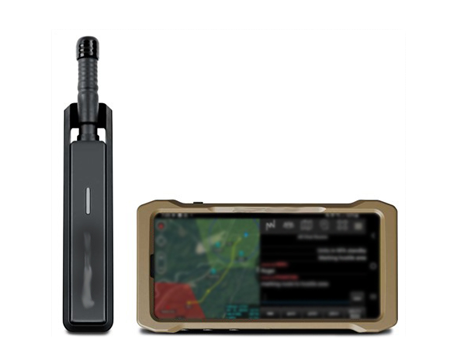
Figure 3. Wireless Mesh Network Radio and Android Tactical Assault Kits (ATAK).
21
Operating within the 445 to 480 MHz range, goTenna devices demonstrated point-to-point communications of over 150 miles under ideal conditions. This field test to pass Position Location Information (PLI) traffic occurred between two mountain peaks (7,600 and 8,800 feet above sea level) in Arizona. The range far exceeded that of many systems operating at 900 MHz or higher, which often fail to reach more than 500 meters under comparable circumstances. However, it is important to note that the field test is more of a proof of concept for using aerial assets (UAV or UAS) equipped with a Pro X2 in relay mode to assist ground troops in mitigating ground-to-ground limitations due to topography.
22
Like other communications technology, the radios may be restricted by topography, but not by power or radio frequency propagation. The low-frequency advantage is essential for remote, advise, and assist operation missions, where ARSOF must sustain secure links with partner forces over distances typically exceeding a kilometer and frequently extending several kilometers. goTenna’s infrastructure-free architecture eliminates the need for gateway nodes and technical support for server IP changes, enabling fully decentralized and dynamic operations. This independence allows ARSOF to execute multiple missions concurrently with various partner forces without relying on external support or pre-established networks.
23
Regarding military free fall operations, the goTenna technology features preconfigured mission toggles that allow seamless transitions from free-fall operations to ground-based communications. This feature ensures near real-time tracking of operators or a partner force during and after military free fall infiltrations.
24 The technology requires very minimal initial training burden and already integrates with the widely used operator Android Tactical Assault Kits (ATAK). The Pro X2 also allows for backhauling through other already employed tactical communication systems (TrellisWare, Silvus, L3Harris, MPU-5), as well as beyond line-of-sight capacity using the high frequency goTenna Skywave module (See Figure 4).
25
Figure 4. High frequency modules provide beyond line-of-sight high frequency capacity to wireless mesh networks.26
From an operational security standpoint, the Pro X2 provides secure end-to-end communication across mesh network “hops” by incorporating advanced encryption standard (AES) 256-bit encryption.
27 This level of encryption is crucial for data protection in contested LSCO environments. Layered encryption further ensures operational security by compartmentalizing mesh network visibility and data access.
28 This enables secure communication with vetted partner forces while safeguarding ARSOF advisors. The device also includes a “remote commander” feature that facilitates the wiping of compromised devices through the mesh network, thus preventing network compromise.
29
The goTenna Pro X2 offers several other features that can significantly enhance the RAA/VAK’s functionality in demanding and restricted environments. The listen-only mode allows for the complete elimination of an operator's electromagnetic signature while still receiving vital mission updates. The device functions as a 5-watt, short-burst data radio that utilizes a transmission randomization protocol, "jittering," to offset transmissions by up to 25 percent before or after the scheduled interval, thereby enhancing low probability of interception, low probability of detection, and countering adversarial direction-finding efforts. Furthermore, the relay mode enables the device to extend coverage beyond physical obstructions, enhancing the resilience of the communication network. Integrated spectrum analyzer capability allows for the detection of radio frequency interference or jamming attempts in real time, improving frequency management and communication effectiveness.
30 Additionally, the system has been successfully tested for integration with UAS, operating as a lightweight (300 grams), line-of-sight wireless mesh network communication device.
31 Overall, these potential mission-enabling wireless mesh network capabilities that address the RAA/VAK’s current limitations provide significant relevance for ARSOF in future LSCO environments.
Operational Relevance for ARSOF in Large-Scale Combat Operations
This tactical communication solution has the potential to directly support ARSOF's core and enabling missions. The technology enhances ARSOF's ability to conduct deep and denied area sensing (ARSOF Line of Effort 1) through a surrogate or a partner force. Long-range, low-visibility SOF team tracking and messaging capabilities facilitate multi-domain operations special reconnaissance and civil network development. Moreover, the capabilities contribute to increased situational awareness for the joint force in the operational and strategic deep areas by leveraging partner placement and access, and the advantages produced by the SOF-Space-Cyber triad. Better communication integration with partner forces and resistance networks enables ARSOF to more successfully prepare and manage these elements when conducting special operations in the enemy's deep areas during LSCO. This solution supports command control of resistance forces through its low probability of intercept and low probability of detection and reduces the risk of fratricide during complex and ambiguous operations behind enemy lines.
32
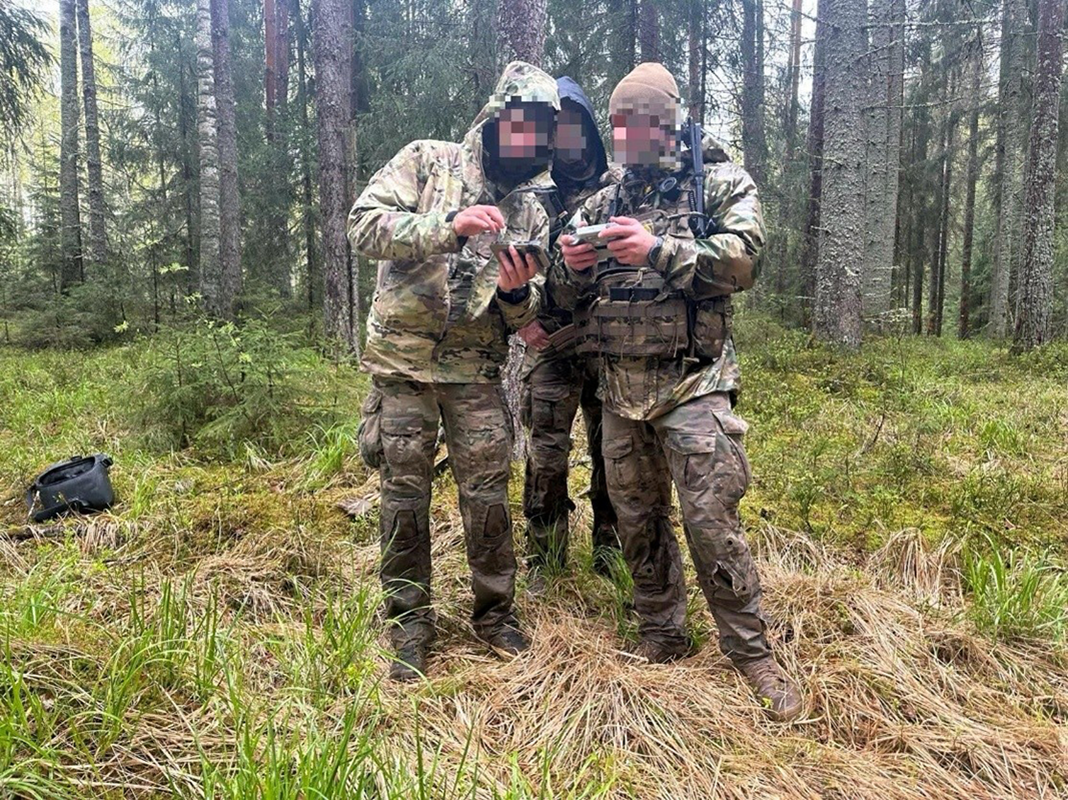
10
th Group SFOD-A utilizes wireless mesh network technology for a deep strike mission during training operations in Estonia. Connecting ATAK devices via wireless mesh network radios, the SFOD-A successfully facilitated close air support for partner force missions on enemy high-payoff targets. (Photo provided by Dr. Daniel Ross)
The wireless mesh network technology provides the greatest advantages to ARSOF in the realm of countering C5ISRT (ARSOF Line of Effort 2) and conducting deep area partner force maneuver (ARSOF Line of Effort 3). Secure partner force communications that do not compromise ARSOF data support strategic sabotage operations against high-payoff and high-value C5ISRT targets out of reach for conventional forces. The near real-time situational awareness, communications, and tracking in politically sensitive or denied environments facilitates remote, advise, and assist operations between friendly, partnered, and indigenous units. These remote, advise, and assist operations efforts strengthen partner forces’ development and help set the conditions for unconventional warfare activities when the environment dictates. Unconventional warfare requires discreet, at times covert or clandestine, communication capabilities for ARSOF to successfully create dilemmas for and impose outsized costs on an adversary. Wireless mesh network technology extends tactical communication contingency plans well beyond current RAA/VAK limitations. This capability, paired with unconventional warfare activities, improves the ability to conduct deep partner force maneuver, disrupt enemy tactical support areas, and expose adversarial strategic flanks.
33
Way Forward
Retrofitting goTenna Pro X2 radios into the RAA/VAK provides a critical upgrade to the existing communications infrastructure. This low-cost, low-footprint augmentation provides ARSOF considerable gains in tactical communication flexibility and operational security, ensuring resilient command and control during multi-domain operations in contested operational environments. The concurrent testing and fielding of a beyond line-of-sight high frequency solution such as the SkyWave Module further expands the RAA/VAK capability by enabling secure, long-range connectivity in austere or denied environments. Collectively, these advancements enhance ARSOF and partner force survivability. Moreover, they increase the likelihood of mission success in future high-risk special operations in enemy deep areas during LSCO. The addition of this technology directly supports the Army Transformation Initiative’s line of effort to “deliver critical warfighting capabilities,” while synchronously contributing a decisive component to the “ARSOF Advantage” for the joint force during future competition, crisis, and conflict.
Author’s Note: Dr. Daniel W. Ross serves in the U.S. Army Special Forces. He teaches graduate-level university courses related to homeland security, homeland defense, and emergency disaster management. Dr. Ross has been published in ProQuest, Special Warfare, Small Wars Journal, and the NCO Journal. The views, opinions, and analysis expressed do not represent the U.S. Army or the Department of War.
Disclaimer: The appearance of third-party products or services does not imply or constitute Department of War or U.S. Army endorsement. The intent of the essay is to encourage professional discourse. The views, opinions, and analysis expressed do not represent the U.S. Army or the Department of War.
References
01 1st Special Forces Command (SFC) G5, “How ARSOF Fights,” 2025.
02 Heather Anderson,
Global SOF: The Asymmetric Strategic Option for a Volatile World, Technical Collection & Communications, 2025; and Clementine G. Starling & Alyxandra Marine, “The role of special operations forces in strategic competition,”
Atlantic Council, March 7, 2024.
03 Anderson, Global SOF, 17.
04 Erik Kramer, “Ukraine Lessons for SOF in Large Scale Combat Operations – Training and Preparation,” SOFX, April 9, 2025.
05 Dan Driscoll and Randy A. George, “Letter to the Force: Army Transformation Initiative,” U.S. Army, May 1, 2025.
06 1st SFC G5, “How ARSOF Fights,” 2025.
07 Ibid.
08 Christopher Thielenhaus, Pat Traeger, and Eric Roles, “Reaching Forward in the War against the Islamic State,”
PRISM: A Journal of the Center for Complex Operations 6, no. 3 (2016): 100; and Christopher Thielenhaus and Eric Roles, “Virtual Accompany Kits Return to Baghdad: A View from the Front Lines,”
Special Warfare 30, no. 2 (2017): 27; and Deane-Peter Baker, “Special Operations Remote Advise and Assist: An Ethics Assessment.”
Ethics and Information Technology 21 (1): 1–10, 2019. https://doi.org/10.1007/s10676-018-9483-3.
09 Anderson, Global SOF, 17.
10 PM – PM-Technical Collection & Communications (PM‑TCC), slides presented at SOFIC 2022, National Defense Industrial Association, May 2022, accessed at NDIA, https://ndia.dtic.mil/wp‑content/uploads/2022/sofic/Tues_PM‑TCC.pdf
11 Roger Sanchez-Vital, Carles Gomez, and Eduard Garcia-Villegas, “Exploring the Boundaries of Energy-Efficient Wireless Mesh Networks with IEEE 802.11ba,”
Internet of Things (Amsterdam, Online) 28. https://doi.org/10.1016/j.iot.2024.101366; and
12 Brian Ellis, “How the U.S. military helped develop mobile mesh networking,”
The Last Mile, July 30, 2020.
13 Reeya Agrawal et al., “Classification and Comparison of Ad Hoc Networks: A Review.”
Egyptian Informatics Journal 24 (1): 1–25. https://doi.org/10.1016/j.eij.2022.10.004.
14 Anderson, Global SOF, 17; and Deane-Peter Baker, 2019.
15 Kennie H. Jones and Jason Gross, “Reducing Size, Weight, and Power (SWaP) of Perception Systems in Small Autonomous Aerial Systems.” In. Langley Research Center, 2014; and Gavin Wright, Line of Sight (LOS), 2022. https://www.techtarget.com/whatis/definition/line-of-sight-LOS
16 Headquarters, Department of the Army, “ATP 3-18.11: Special Forces Military Free-Fall Operations,” April 2025.
17 NATO Channel, “HALO jumping with the Lithuanian Special Forces (international version),” June 23, 2020. https://www.europeafrica.army.mil/What-We-Do/Exercises/Noble-Partner/videoid/761368/dvpTag/Lithuanians/; and 1st SFG(A) PAO, “Green Berets with 1st Special Forces Group (Airborne) spent the last month training with operators in the Japanese Special Operations Group (JSOG),” 2024. https://www.instagram.com/reel/C5EqGJjPxQ3/
18 Nancy Jones-Bonbrest, “Cutting through the noise: Army, industry work together to speed up signal detection,” Army Rapid Capabilities Office, 2019; and Jasmyne Douglas, “Army spectrum-sensing technology to help units avoid detection,” DEVCOM C5ISR Center Public Affairs, 2021.
19 Ryan Schradin, “Unlocking drone potential: How mobile mesh networking enhances tactical operations for public safety and military operators,”
The Last Mile, November 2, 2023
20 goTenna, “Pro X2: Enhanced performance. Low Profile,” 2025. https://gotennapro.com/products/gotenna-pro-x2
21 Ibid.
22 Ibid.
23 Ibid.
24 Headquarters, Department of the Army, “ATP 3-18.11,” 2025.
25 Soldier Systems, “SOF Week 24 – GoTenna SkyWave,” May 13th, 2024. https://soldiersystems.net/2024/05/13/sof-week-24-gotenna-skywave/
26 Ibid.
27 National Institute of Standards and Technology (NIST), “Announcing the Advanced Encryption Standard (AES),” FIPS PUB 197, Update 1 (Gaithersburg, MD: U.S. Department of Commerce, August 2023), https://nvlpubs.nist.gov/nistpubs/FIPS/NIST.FIPS.197-upd1.pdf.
28 Ofer A. Lidsky, “Understanding Data Encryption: Types, Algorithms and Security,”
Forbes Technology Council, November 22, 2024, https://www.forbes.com/councils/forbestechcouncil/2024/11/22/understanding-data-encryption-types-algorithms-and-security/.
Forbes
29 goTenna Pro Knowledge Base, “Guide to Using the goTenna Pro X2 with the iTAK Plugin,” support article, accessed August 18, 2025, https://support.gotennapro.com/s/article/Comprehensive-i#remote-commander.
30 goTenna Pro X2 User Guide, Updated November 11, 2024. https://gotenna.my.salesforce.com/sfc/p/#36000000v3TZ/a/WQ000000L2ur/XWScywlaWQ5mSkiiGsZxCszOqbpXTHwDncWKqHEiArU
31 Dan Taylor, “New Mesh Networking Device for Uncrewed and Autonomous Systems Launched by goTenna,”
Military Embedded Systems, May 12, 2025, https://militaryembedded.com/comms/communications/new-mesh-networking-device-for-uncrewed-and-autonomous-systems-launched-by-gotenna
32 1st SFC G5, “How ARSOF Fights,” 2025; and Headquarters, Department of the Army, “FM 3-05: Army Special Operations,” June 2025
33 Ibid.