Editors’ Note: The authors highlight the effectiveness of integrating artificial intelligence (AI) tools into military exercise design. They highlight several examples that they have implemented in the Civil Affairs Qualification Course culmination exercise, named Operation Sluss-Tiller. By enhancing efficiency, scalability, and flexibility, AI systems redefine training environments to deliver tailored, immersive experiences. These tools enable the creation of responsive and detailed simulations, resulting in amplified outcomes for Soldiers preparing to fight on the modern battlefield.
Introduction:
The U.S. Army is beating the drum of modernization and transformation. From combatant commands to the squad and team, every unit and Soldier feels the pace of change. Yet many training exercises remain tied to legacy formats developed during the Global War on Terror, producing scenarios and control processes that are increasingly misaligned with the demands of large-scale combat operations (LSCO), contested information environments, and accelerated decision cycles.
Exercise professionals know the problem. Updating scenario products can be a colossal task conducted by a small number of people working against hard timelines. Even after revision, execution strains the bandwidth of the exercise control group (ECG). White cell and red cell personnel must answer requests for information (RFIs), adjudicate events, inject master scenario events list (MSEL) actions, manage role-player networks, and still sustain the administrative workload that keeps an exercise running. In many exercises, the limiting factor is not imagination or training intent — it is manpower and time.
The hard truth is that outdated design approaches and rigid exercise management methods stall transformation. They limit scenario depth, reduce responsiveness, and drive exercises toward static “scripted theater” rather than dynamic training.
Artificial intelligence changes that equation. AI does not replace human planners. It amplifies them.
Thesis: AI empowers small exercise control teams to deliver the realism, responsiveness, and depth of large-scale exercises by scaling scenario management, stakeholder engagement, content generation, and knowledge delivery—while preserving critical human judgment.
Before detailing each use, it is worth stating the most important principle of AI integration in training: AI outputs are drafts. Humans remain the release authority. AI enables speed and scale, but exercise realism and instructional alignment require judgment, restraint, and governance.
1. AI as a Cognitive Partner in Complex Scenario Design
A large-scale special operations forces (SOF) exercise is an interactive narrative ecosystem with hundreds of characters, intersecting plotlines, and a deep repository of scenario “lore.” The core challenge for human designers is continuity: keeping timelines coherent, maintaining consistent actor motivations, and ensuring injects align with established ground truth across thousands of pages of scenario material.
In practice, scenario complexity can overwhelm even experienced exercise planners. Integrating operational orders, character backstories, area studies, intelligence threads, and the MSEL creates a volume problem. When design teams change one event, they must account for downstream effects across multiple training audiences, role-players, and operational timelines.
AI solves this problem by serving as a deputy scenario manager: a continuity engine that reduces cognitive load and keeps the exercise coherent.
By training a Large Language Model (LLM) on the full body of exercise materials — operational orders, character backstories, area studies, and the master scenario events list — design teams gain a reliable partner for rapid fact-checking and scenario control. The AI tracks relationships across key actors, monitors simulated resource status, and flags timeline conflicts when new events are introduced. This offloads the burden of managing thousands of interdependent details, allowing the human team to focus on higher-value work: designing challenging problems, adapting to trainee decisions, and driving learning outcomes.
Most leaders are familiar with exercise libraries that have grown one page at a time into an unmanageable, unreadable blob. These piles become impossible for students or even managers to learn. Now, AI optimizes onboarding processes by condensing massive amounts of information into clear, concise summaries. Whether tasked with providing a strategic overview of factions or delivering contextual insights on historical sites and relevant personnel, AI systems bridge knowledge gaps quickly and effectively.
Operation Sluss-Tiller vignette 1
- AI Prompt: “If we introduce an enemy assassination on Day 3, which previously planned friendly meetings on Day 4 would be logically canceled or altered?”
Takeaway: AI provides the volume capacity to manage massive scenario ecosystems, enabling small teams to build and maintain complex exercises without sacrificing narrative consistency or instructional intent.
2. AI to assist in Reachback and Exercise Depth
Exercises become immersive when trainees can leverage credible reachback: expert networks, professional stakeholders, and institutional actors who respond in ways that feel operationally authentic. In the real world, commanders and staff do not operate alone. They call higher headquarters, consult legal advisors, reach engineers, coordinate logistics, and negotiate with civilian leadership under constraints. In traditional exercise design, realistic reachback requires extensive staffing. Without that staffing, interactions degrade into generic role-player responses, delayed answers that disrupt tempo, hand-waved solutions that reduce realism, and unconvincing stakeholder behavior that undermines training. AI solves this by generating credible reachback and stakeholder responses at scale, without expanding the exercise control staff.
With minimal input, AI can simulate key figures with accurate expertise, consistent tone, and realistic priorities — producing nuanced responses that feel operationally authentic. By integrating profession-specific decision frameworks and referencing large bodies of doctrine, regulations, laws, and policies, AI can respond like a diligent police chief operating under legal constraints, a division G4 balancing logistics under stress, a mayor navigating competing interests and adversarial pressure, or a student activist shaping momentum through public sentiment. This embeds expert-level realism into the scenario and allows small teams to deliver depth and responsiveness once only achievable with a large, specialized role-player roster.
- AI Prompt: List the key information the XO of the 602nd SMC would require to assess and approve the request to fabricate component X for a civilian generator.
- AI Prompt: Generate a tactful and guarded response from Fire Station 12’s chief regarding how enemy sabotage has affected their response effectiveness
3. Dynamic Content Generation
In the culminating Civil Affairs Qualification Course exercise, Operation Sluss-Tiller, scenario managers use AI to maintain key personalities that students develop during the competition phase. Students who engage with the real-world county fire chief or engineer at a hydroelectric dam, can now reach back and leverage that relationship/network.
• A fire station chief writes a quick email between missions.
• A student activist sends a theory-saturated report of what she sees on campus.
• A US Army logistician asks detailed RFIs to support a tasker.
Operation Sluss-Tiller vignette 2
Modern warfare is a battle of narratives. Training exercises must reflect that reality. Units operate inside contested information environments shaped by propaganda, misinformation, rumor cascades, and competing truths. Manually generating a high-fidelity information environment is labor-intensive; even a strong ECG red cell struggles to produce enough content quickly enough to match trainee tempo. The result is often static: a handful of pre-scripted articles and social posts that fail to evolve with trainee decisions.
AI solves this by generating high-fidelity information injects at scale, allowing control cells to stay responsive and adaptive throughout execution.
Beyond individual messages, AI allows scenario managers to simulate entire audiences —thousands of people observing, interpreting, and reacting to events in real time. Scenario managers pre-build audience profiles with demographics, interests, historic references, loyalties, and speaking styles, enabling organic outputs like social media posts, local news stories, and comment-section engagement. As trainees conduct civil engagements, counter adversary messaging, or create unintended effects, these factions detect changes, form narratives, and respond immediately. This creates rapid feedback loops that allow trainees to assess measures of performance and effectiveness and adjust their operational approach under realistic pressure.
- AI Prompt: “Generate 10 simulated social media posts reflecting the visibility and response of Factions A, B, and C to ongoing protests from 0300–0800 in specified neighborhoods.”
- AI Prompt: “Draft a 200-word article for the Republic Herald attributing the cause of local protests to US presence. Include a comment section reflecting viewpoints from Factions B, D, and E, featuring statements from Influencer [X]. Provide estimated audience engagement metrics.”
- AI Prompt: “Write a biased news article from an anti-American perspective describing the aftermath of the friendly forces' artillery strike last night.”
Takeaway: AI allows the ECG to create a reactive and dynamic information environment that responds directly to trainee actions, forcing units to fight for control of the narrative in a way that is almost impossible to achieve manually.
4. Democratizing Knowledge for Agile Exercise Management
One of the most persistent problems in exercise management is the single point of failure: one or two members of the ECG become the sole keepers of critical scenario knowledge. When trainees ask detailed questions or role-players need fact-checking, execution slows while the correct “guru” is found.
The solution is not necessarily more personnel, but better AI and better tools that distribute scenario knowledge across the team.
By making large repositories instantly searchable, AI enables the entire exercise control staff to answer RFIs with confidence and adjudicate events consistent with the established “ground truth” of the scenario. New personnel can review and internalize historical and strategic premises from extensive area studies in minutes, then apply those insights without breaking continuity. This reduces scenario acclimation time, accelerates decision-making, and allows the team to stay focused on operational objectives. Instead of relying on a single “guru” who wrote or memorized the scenario, exercises become resilient, scalable, and sustainable, even through routine turnover.
- AI Prompt: “What is the name of the police chief in the town of Pineland?" or "Summarize all intelligence reports related to the UFWDs activity in the last 2-months."
Takeaway: This empowers the entire exercise control staff, eliminates information silos, and enables sustainability by accelerating onboarding and reducing fragility when key personnel rotate out.
5. Data-Driven Trainee Analysis
To truly train modern staff work, trainees must wrestle with raw data—not pre-digested narrative summaries. Units today operate inside “data fog”: massive volumes of partial information, ambiguous indicators, competing reporting, and uncertain trendlines. Yet many exercises still rely on simplified reporting because producing complex datasets by hand is slow and unsustainable.
AI solves this by rapidly generating complex, realistic datasets that trainees must analyze using real tools and methods.
Information Warfare (IWar):
Using AI tools like ChatGPT and DALL-E, the ECG generated a high volume of realistic ION (information operations network) media injects, including articles from sources like The Washington Post, tweets from OsintTV, and other simulated news reports with competing narratives.
Operation Sluss-Tiller vignette 3
AI can produce large data products — public opinion surveys, economic indicators, service delivery metrics, atmospheric and infrastructure data — that simulate operational ambiguity at scale. Trainees then use tools like Power BI or Python to clean the data, identify trends, and deliver defensible, data-driven recommendations. Scenario designers can depict sentiment shifts, political leanings, and population vulnerabilities tied to shortages, disruptions, intimidation, or governance gaps, forcing students to build conclusions that enable decision-making. AI can also support scenario management by introducing indicators of adversary proxy activity, staging, and sabotage preparations, creating deeper intelligence problems and tighter alignment to measures of performance and effectiveness.
- AI Prompt: “Identify indicators in Sites A, B, and C that suggest adversary SOF proxies are preparing sabotage activities ahead of Joint Forcible Entry operations.”
Example: Mission Command System-Common Operational Picture (MCS-COP) Data Layers
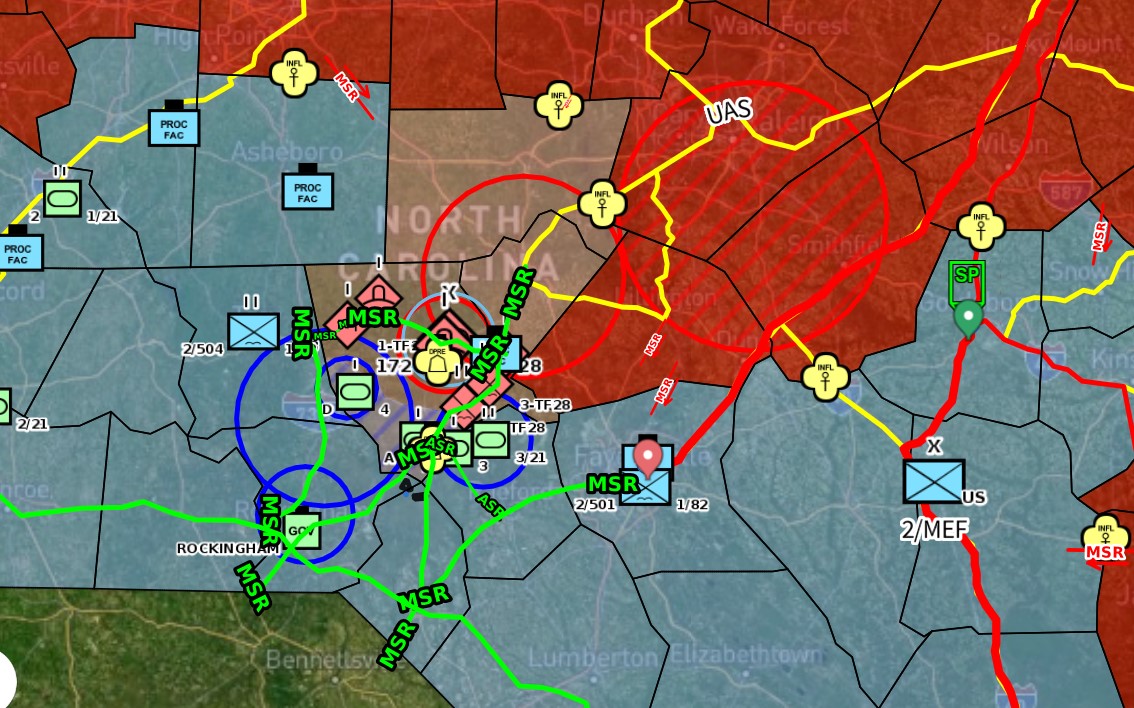 Scenario managers update a common to all “layer” on MCS-COP. This layer includes enemy attacks and friendly maneuver graphics that students can analyze and make real-time decisions / reactions. AI products are integrated into the reports and assist with building layers based on enemy TTPs and training objectives.
Operation Sluss-Tiller vignette 4
- AI Prompt: “Outline indicators within Area C’s civil component that signify Adversary TF 2-12 staging to penetrate Host Nation forces located 10 km south.”
Takeaway: Data is the language of today. AI enables scenario managers and trainees alike to generate, analyze, and interpret complex datasets with speed and accuracy — supporting objective, measurable training outcomes with a human-in-the-loop controlling the data inputs and prompts.
Integrating AI into other Platforms
AI is a phenomenal tool, and the five uses of AI described in the article are useful if you have the programs and platforms available to harness the content. Army programs of record, such as Palantir’s MCS-COP or Maven, provide an excellent venue to update AI-produced outcomes in real-time. In Operation Sluss-Tiller, MCS-COP layers are updated daily to provide real-time enemy and intelligence updates. These updates are dropped onto the students’ common operating picture and provide higher echelon data, enemy activity, and operations that must be analyzed and included in their daily battle rhythm. This provides the students with immediate consequences and feedback from their previous day’s operations. In the layer, enemy icons and reports include information on the activity or intelligence summary. It is the student’s responsibility to then incorporate this information into their effects working group and commander’s priorities.
Example: Survey Data
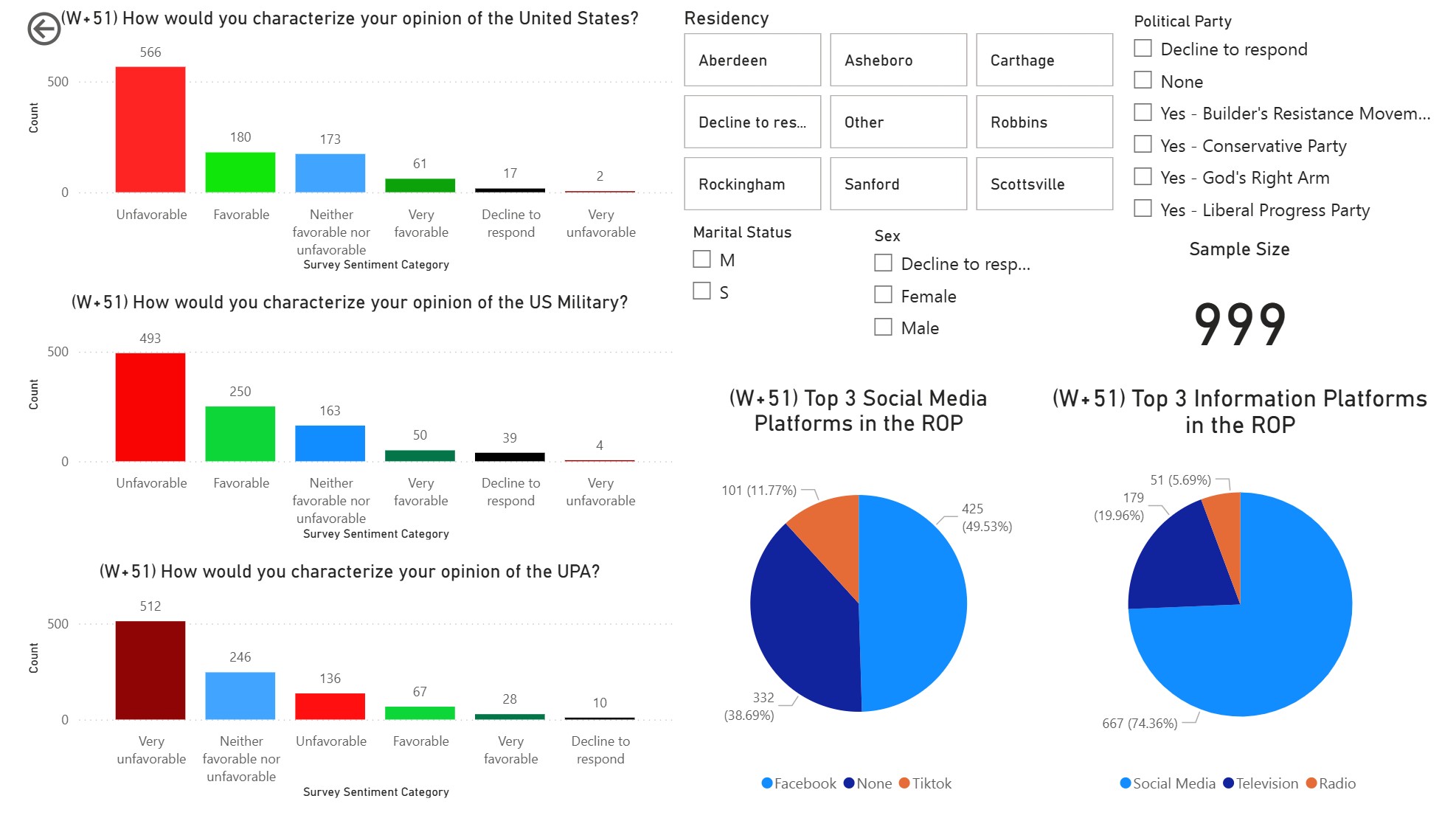 Students used Microsoft Power BI to analyze and draw conclusions from the survey data. Power BI can turn raw data into easily digestible information in the form of graphs and percentages. Students were able to use this analysis to better understand the population’s bias, opinions, influences, most popular social media outlets, and political leanings.
Operation Sluss-Tiller vignette 5
The information operations network is equally important in replicating a synthetic, exercise internet. This open-source forum provides students with the ability to query and analyze the information space. These articles, tweets, posts, and videos in the information domain create opportunities to train students on information warfare. It also allows them to combat misinformation, disinformation, and create their own content. AI enables a few scenario managers that have the capacity to keep up with a much larger training audience and provide near-instantaneous products based on student actions and external actors.
The Transformation of Operation Sluss-Tiller
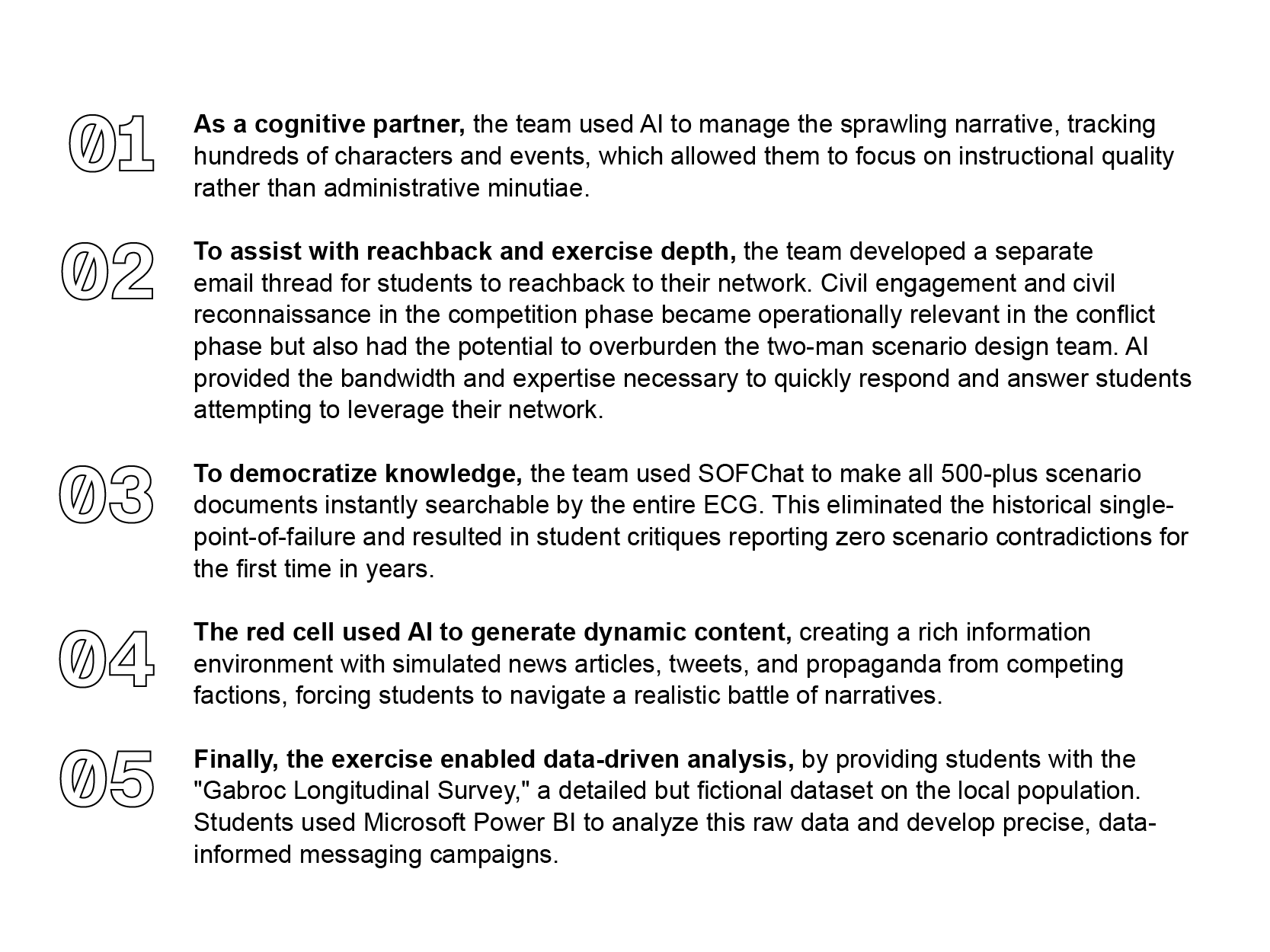
The modernization of Operation Sluss-Tiller, the capstone exercise for the U.S. Army Civil Affairs Qualification Course, serves as a powerful proof-of-concept for these five principles. Tasked with rewriting over 2,000 pages of material to shift from a counterinsurgency focus to a LSCO scenario, a small two-person team turned to AI as a force multiplier.
Their experience provides a concrete example of the five points in action:
 Conclusion
The integration of artificial intelligence into exercise design and management is not about replacing the human planner but empowering them. The transformation of Operation Sluss-Tiller demonstrates that these five principles are not theoretical; they are practical, field-tested methods for creating training that are more rigorous, efficient, and relevant. By leveraging AI as a cognitive partner, a knowledge manager, a content generator, a data provider, and a persistent assistant, we can build training environments that truly prepare our military forces for the complex challenges of the future battlefield.
Authors’ Notes:
Major Josh Corson is a career Regular Army Soldier and Civil Affairs Officer with more than 13 years of service. He currently serves as a Company Commander responsible for Operation Sluss-Tiller, the culminating exercise of the Civil Affairs Qualification Course.
Major Paul Kuemmerlein is a career regular Army Soldier and Civil Affairs officer with 12 years of service. He currently serves as the course manager for Operation Sluss-Tiller, the culminating exercise of the Civil Affairs Qualification Course.
The views, opinions, and analysis expressed do not represent those of the U.S. Army or the Department of War.