The United States (U.S.) Army Special Forces (SF) Regiment should strongly consider making “method of instruction” (MOI) a more prominent aspect of entry-level Green Berets’ education to remain competitive within the irregular warfare domain. The crux of the problem is that aspiring Green Berets attending the Special Forces Qualification Course (SFQC or Q-Course) receive only a small block of instruction concerning MOI. In basic terms, MOI is a type of activity used in conjunction with an instructional strategy to facilitate the accomplishment of specific learning objectives.
1 Green Berets are expected to be the military’s premier warrior-teachers. They serve as the Army’s unconventional warfare (UW) experts and force multipliers due to their ability to train, advise, and assist foreign military forces.
2 They are also tasked with executing foreign internal defense (FID), security force assistance (SFA), and counterinsurgency (COIN), and with fulfilling combat advisor roles across every area of responsibility (AOR).
3 Yet, instilling the essential skills necessary for these SF advisors to teach, coach, and mentor their teammates, as well as eventually foreign partner forces (PF), remains a deprioritized effort during the initial SF training pipeline.
The purpose of this article is to present an argument for the importance of MOI as an irregular warfare tool for the SF Regiment, to outline the MOIs most relevant to SF conducting irregular warfare activities, and finally to offer a recommended course of action (COA) for improving the SFQC with increased MOI education and training.
First, certain MOIs are more useful to irregular warfare activities. Mastery of these methods enables SF advisors to:
1. Develop cross-cultural competence
2. Generate force-multiplying effects
3. Support enduring host nation (HN) resistance and resilience efforts
4. Strengthen the legitimacy and strategic influence of PFs in the context of irregular warfare
Second, by providing aspiring Green Berets with a more robust understanding of how to pair instructional strategies with suggested MOIs, the SFQC will enable them to be more effective teachers while conducting various missions under the irregular warfare umbrella.
4 Lastly, the article offers a COA to enhance the SFQC, emphasizing the importance of instructional competence within the UW and FID core tasks central to the SF Regiment’s expertise in the irregular warfare realm.
5 If the SF Regiment strives to achieve a higher level of supremacy in irregular warfare, it is time to prioritize MOI and develop future SF advisors as highly effective instructors from the outset of their careers.
Diving Deeper into the Problem
Teaching is an inherent function of military service.
6 Entry-level SF soldiers are expected to report to their assigned Special Forces Group and be capable teachers. Yet they do not receive any substantive formal instructor or teacher training until many years later. This typically only occurs if they return to the U.S. Army John F. Kennedy Special Warfare Center and School (USAJFKSWCS or SWCS) for a broadening assignment to become a highly qualified cadre. As it stands, there are numerous points in the recent evolution of the SFQC that highlight this problem.
SFQC selectees attend only a one-week orientation to the training pipeline and no longer receive the training course “Introduction to Unconventional Warfare” that existed circa 2010. Education on method of instruction only occurs at the beginning of the small unit tactics (SUT) portion of the Q-Course. The brief PowerPoint lecture has effectively become a perfunctory, check-the-box requirement that allows SF students to receive Advanced Leader Course (ALC) credit (a noncommissioned officer professional military education (PME) requirement) upon graduation from the SFQC. Furthermore, FID training was removed from SUT shortly before the Q-Course reverted from the optimized model in 2021. Robin Sage, the SFQC’s two-week CULEX, remains the sole UW-based experience that students navigate during their initial training.
7 Consequently, SFQC students do not receive a specific course that meaningfully develops proficiency in MOI.
After graduating from the SFQC, SF noncommissioned officers do not receive formal PME on the SF principal tasks until they attend the Senior Leader Course (SLC), years after earning the Green Beret. Formal instructor training that emphasizes MOI is not undertaken until they return to SWCS for a tour as cadre many years later. Once at SWCS, incoming cadre are required to complete the Common Faculty Development-Instructor Course (CFD-IC) within 60 days of arrival through the Staff and Faculty Development Division (SFDD).
8 Regrettably, this task is sometimes hard to accomplish due to certain training committees’ workflow demands not synchronizing with course availability. The current environment forces some incoming instructors to spend their initial six months to a year onboarding and training to become fully certified and qualified instructors.
For example, SUT requires a new instructor to attend onboarding, a master trainer course, CFD-IC, and observe a class before becoming an assistant instructor (AI) and progressing to primary instructor (PI) status. The shortest amount of time to accomplish these certifying and qualifying tasks is approximately six months, but it may sometimes be longer if a new cadre must first complete other PME, such as SLC. Occasionally, this process accounts for as much as one-third of the typical SWCS tour, with the instructor returning to the operational force after only two years of actual instructor time. Mitigating these inefficiencies and placing a greater emphasis on MOI in SF entry-level training generates an advantage for U.S. Army Special Operations Forces (ARSOF) during future irregular warfare campaigns.
MOI: An Irregular Warfare Advantage
A thorough understanding of the MOI tools at an SF advisor’s disposal provides an irregular warfare advantage to ARSOF. The intersection of important SF principal tasks (UW, FID, SFA, COIN, and CT) with named irregular warfare activities underscores the importance of developing SF advisors as effective teachers and instructors early in their careers.
9 Foremost, new Special Forces Operational Detachment-Alpha (SFOD-A) team members need the capability to plan, develop, and teach all aspects of their primary military occupational specialty (MOS), as well as other individual SF skillsets, to the rest of the team. Cross-training allows each member of the detachment to become a master of the basic tasks required of ARSOF soldiers. By mastering the basics, each team member gains the ability to effectively teach fundamental soldiering tasks to PFs worldwide. Proficiency in MOI equips SF advisors with the capacity to cultivate cross-cultural competence, achieve force multiplication, contribute to long-term resistance and resiliency efforts, and enhance the legitimacy and strategic influence of PFs during irregular warfare activities.
Effective collaboration with allies and partners requires cross-cultural competence.
10 An SF advisor's level of cultural intelligence (drive, knowledge, strategy, and action) in cross-cultural situations determines whether success or failure will result from operating with partners in complex and unstable environments.
11 Some MOIs are better suited to different partners and different cultures. SF Advisors apply different MOIs to adjust instruction based on local contexts, thereby avoiding a one-size-fits-all mentality. During FID, tailoring the correct MOI to a PF’s culture and overarching population dynamics helps to iteratively refine enduring HN SOF capabilities by establishing relationships and rapport. This enables SF advisors to have an outsized impact through force multiplication and indigenous capacity-building efforts.
12
SF advisors enhance PF capacity by teaching and training indigenous forces. They leverage these relationships as force multipliers to advance mutual security objectives while reducing the U.S. government’s footprint, operational risk, and overall cost.
13 Effectively employing MOI permits SF advisors to indirectly enhance partner combat power and create dilemmas for an adversary without engaging in unilateral direct action. For example, teaching guerrilla tactics and mission command through an effective multi-MOI approach facilitates PF capability to fight on their own terms. Coupling an understanding of MOI to the “through or with” concept central to many aspects of irregular warfare remains paramount for cultivating long-term, deep relationships.
14
Many SF principal tasks under the irregular warfare umbrella involve building capacity or sustaining long-term resistance and resiliency efforts in partner nations. Instructional competence and understanding the correct methods to employ based on the operational environment contribute to a resistance movement or PF’s ability to retain skills after SF advisors depart.
15 For example, the 10
th Special Forces Group (Airborne)'s early FID efforts in 2015 Ukraine produced the first cadre of Ukrainian SF capable of teaching subsequent iterations of the Ukrainian SFQC.
16 U.S. SF advisors employing a diverse array of MOIs during the nascent Q Course were critical to building Ukrainian military capacity and to sustaining HN resistance and resilience efforts.
17 Producing a cadre of local SOF trainers who continued to transmit irregular warfare knowledge and tactics across future cohorts of fighters eventually helped undermine and diminish Russia’s 2022 attempt at conquering Ukraine.
18 Overall, the ability to train indigenous forces to train themselves remains decisive to fortifying partner nation legitimacy and developing the capacity to succeed over the long term.
19
The concept of legitimacy stands at the core of irregular warfare.
20 The effectiveness of an HN’s political and military efforts ultimately depends on state or non-state actors' ability to secure and sustain the consent of relevant populations.
21 Professional SF advisors understand that MOI is not merely a technical formality, but a means to demonstrate credibility and a desire to invest in their partners. Empowering a PF reinforces the legitimacy of the military and, subsequently, the governing body in the eyes of the populace.
22 Building partner trust and confidence through joint training and shared experience strengthens irregular warfare outcomes and creates strategic effects.
23 Therefore, the time has come to emphasize and integrate MOI as a crucial aspect of irregular warfare practice within the SF Regiment.
Integrating Irregular Warfare, Instructional Strategy, and MOI
A starting point involves increasing exposure to the Army Learning Model in the SFQC and allowing aspiring Green Berets more practice in effectively employing different MOIs for specific instructional strategies. Instructional strategies organize and identify learning activities, methods of instruction, and content delivery to emphasize learning concepts, theories, and ideas. There are five identified instructional strategies under the Army Learning Model designed to impart knowledge using specific MOIs.
24 MOIs are the activities used in conjunction with an instructional strategy to facilitate the accomplishment of identified learning objectives. Some instructional strategies are more appropriate for executing irregular warfare activities than others.
25 Nevertheless, a basic understanding of all available instructional strategies and the MOIs best suited to executing them remains important for SF advisors who teach, coach, and mentor partners in ambiguous environments across the globe.
Instructional Strategies
The Army Learning Model focuses on outcome-oriented instructional strategies to foster critical thinking and initiative. Five main strategies allow instructors to tailor operationally relevant information to the learning audience and desired outcomes. Selecting a strategy ultimately influences the instructor’s choice of MOI, media, and learning environment. The five instructional strategies include: direct instruction, independent study, indirect instruction, collaborative or interactive instruction, and experiential learning.
26
Direct Instruction
Direct instruction emphasizes modeling expert performance to guide learners in mastering specific tasks or problem-solving approaches. This method assumes that learners can replicate expert behavior when material is presented systematically in a structured, part-to-whole sequence.27 Direct instruction organizes and sequences content into smaller, manageable segments, integrating new knowledge with learners’ prior understanding through demonstrations, lectures, and guided practice. Additionally, instructors often supplement lectures with a variety of instructional tools, including case-based readings, handouts, and interactive multimedia resources, to reinforce critical information and enhance learner engagement.28
Independent Study
Independent study acknowledges that learning can be a personalized process, allowing students with diverse learning preferences and varying schedules to progress at their own pace. The learning experience is supervised by a subject matter expert, but the learner studies the subject autonomously. This strategy shifts responsibility for learning from the instructor to the learner.
29 For example, Army Credentialing Opportunities On-Line helps soldiers find information on certifications and licenses related to their military occupation. The Army Credentialing Assistance Program then pays for them to achieve that credential, typically through various independent study programs.
30
Indirect Instruction
Indirect instruction encourages learners to actively construct their own understanding rather than simply receiving information from an instructor. The knowledge they develop emerges through personal interpretation, differing from both the presented content and their prior responses. Like independent study, this approach places the primary responsibility for learning on the learner rather than the instructor.
31
Collaborative or Interactive Instruction
Collaborative or interactive instruction emphasizes participant discussion and knowledge sharing as central components of the learning process. The instructor must clearly define the topic, allocate appropriate discussion time, determine group composition, and establish methods for reporting or sharing outcomes. The effectiveness of this instructional approach largely depends on the instructor’s expertise in organizing and managing group dynamics to foster meaningful engagement.
32
Experiential Learning
Based on Kolb’s experiential learning model, this strategy prioritizes inductive, learner-centered, and activity-based approaches that involve personal reflection on experiences and the creation of plans to transfer learning to new contexts. Experiential learning operates as an iterative process consisting of five essential phases.
33 The five phases include: concrete experience, publish and process, generalize new information, develop, and apply (check on learning).
34
Among these five instructional strategies, direct instruction, collaborative or interactive instruction, and experiential learning emerge as the three most effective approaches for supporting SF irregular warfare initiatives. Direct instruction is the primary means by which SF advisors internally improve the organization and train foreign PFs. SF advisors are expected to be masters of the basics and subject matter experts in special warfare. They model expert performance and expect learners to replicate expert behaviors. SF also employs collaborative and interactive instruction to conduct MOS cross-training and facilitate mutually beneficial learning exchanges with partner nation militaries. Experiential learning represents the bedrock of SF instructional efforts. Special Forces remain the partner of choice for U.S. irregular warfare efforts in many regions due to their unparalleled experiential knowledge gained through decades of concrete special warfare operations.
35 The effectiveness of these strategies depends on understanding the appropriate contexts for their application and selecting MOIs that most effectively align with and achieve the intended learning objectives.
Method of Instruction
To be successful at irregular warfare, SF advisors must employ cross-cultural awareness to establish rapport with HN counterparts and then teach a wide array of technical military skills, often in a foreign language or through an interpreter. They need to foster mutual understanding and navigate numerous challenges, including miscommunications and mistrust, that inevitably arise when cultures vastly different from one another collaborate on complex military tasks. Success in tasks such as FID, SFA, and UW hinges on an SF advisor’s credibility and power to develop partnerships.
36 These potential gains stem from SF's ability to demonstrate technical and tactical mastery and then effectively teach, coach, and mentor partners to achieve similar levels of accomplishment. An important irregular warfare tool contributing to this success is the appropriate selection of MOI, paired with the appropriate instructional strategy (in this case, direct, collaborative, or experiential learning). Deliberate MOI selection, informed by a nuanced understanding of the learning environment and the characteristics of adult learners, facilitates the accomplishment of specified learner objectives during both SF MOS cross-training and training foreign PFs (See Figure 1).
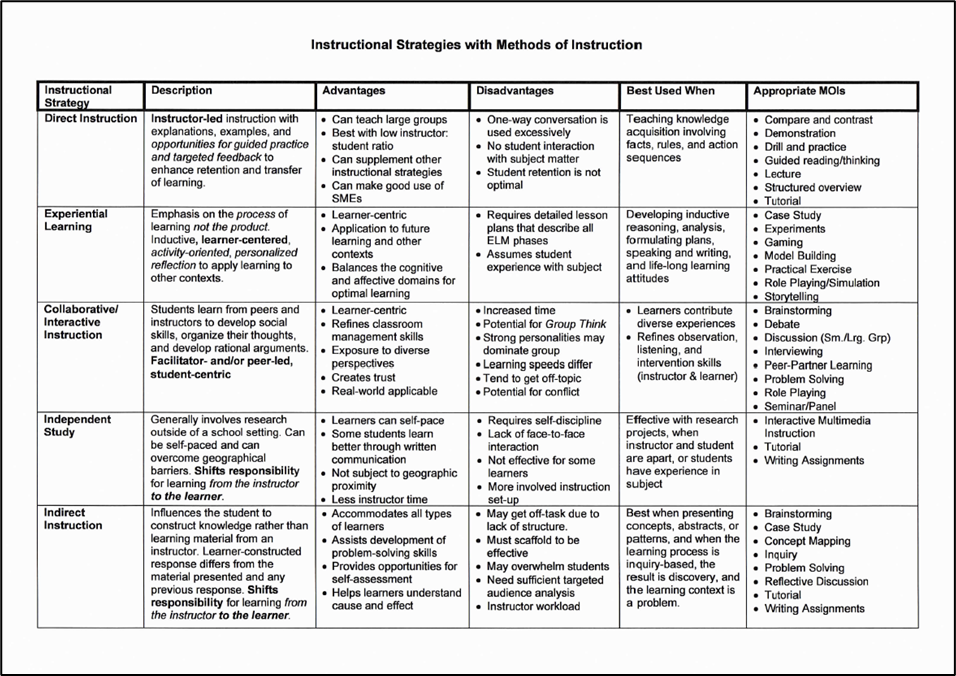
Figure 1. Instructional Strategies and Methods of Instruction Overview (chart provided by the Staff and Faculty Development Division of the U.S. Army John F. Kennedy Special Warfare Center and School).
37
MOIs for Direct Instruction
Direct instruction should be employed to teach facts, rules, and action sequences. The best MOIs for direct instruction include: compare and contrast, demonstration, drill and practice, guided reading and thinking, lecture, structured overview, and tutorial (See Figure 2).
38 Direct instruction by SF involves structured, hands-on teaching methods in which Green Berets explicitly model, demonstrate, and guide PFs in skills or tasks. Direct instruction is highly focused on replicating expert performance through systematic explanation and practice. For example, SF soldiers demonstrate the proper firing techniques for various weapons systems, followed by guided practice with PFs. Other examples include providing step-by-step instruction on small unit tactics, close quarters battle, demolition, breaching, combat medicine, and communications. Direct instruction fosters confidence, standardization, interoperability, and operational readiness on each SFOD-A and between partner military units.
| Method of Instruction |
Definition |
Applied IW Example |
| Compare and Contrast |
Comparing two things is telling how they are alike; whereas, contrasting two things is telling how they are different. |
Block of instruction to the PF on the similarities and differences between an ambush and a raid.39 |
| Demonstration |
Performing an activity so that learners can observe how it is done to help prepare learners to transfer theory to practical application. |
SF advisors leading by example and demonstrating how to conduct specific battle drills.40 |
| Drill and Practice |
Drill and Practice, like memorization, involves repetition of specific psychomotor or cognitive skills (addition and subtraction, spelling, marksmanship). |
SF-supervised practice of basic rifle marksmanship (BRM) by an irregular partner force during a UW campaign supporting large-scale combat operations.41 |
| Guided Reading and Thinking |
Learner’s comprehension of a selection is guided and developed by instructor/facilitator questions. The focus is on the use of context to predict meaning. |
Providing PF reading material on the principles of mission command during FID to help build partner capacity.42 |
| Lecture |
An oral presentation intended to present information about a particular subject within a limited time frame. |
Didactic instruction on how to counter threat networks within the HN.43 |
| Structured Overview |
Verbal, visual, or written summary or outline of a topic. |
Providing a structured overview or summary of how to use Troop Leading Procedures to HN students for use in planning small-unit operations.44 |
| Tutorial |
A form of remedial or introductory assistance provided to a learner or a small group of learners with maximum learner interaction. |
An interactive “talk-through, walk-through” with a guerrilla or surrogate force on how to emplace and execute a linear or L-shaped ambush.45 |
Figure 2. Methods of Instruction suited to Direct Instruction (Chart provided by Dr. Daniel Ross).
46
MOIs for Collaborative or Interactive Instruction
Collaborative or interactive instruction provides many peer-based learning benefits to SF operators. Some of the most appropriate MOIs include: brainstorming, cooperative learning groups, debates, discussion (small or large groups), interviewing, peer partner learning, problem-solving, role-playing, seminars, and tutorials (See Figure 3).
47 Some examples include guiding PFs through collaborative planning sessions or workshops concerning troop leading procedures or the military decision making process (MDMP). After action reviews also represent an important aspect of learning following joint training exercises or operational missions where SFOD-As and their partners can discuss what went well and what can be improved. Moreover, intelligence sharing and target analysis between the SFOD-A and the PF create collaborative learning environments. Field Training Exercises (FTX) and Tabletop Exercises (TTX) are also collaborative and interactive learning methods that SF can employ with PFs.
| Method of Instruction |
Definition |
Applied IW Example |
| Brainstorming |
A method of generating ideas to solve a problem. This can be done by an individual or by a group. |
SF advisor facilitating open communal discussion with a PF on MDMP Step III: Course of Action (COA) Development.48 |
| Cooperative Learning Groups |
A method in which small teams, each with learners of different levels of ability, use a variety of learning activities to improve their understanding of a subject. |
Bilateral knowledge-sharing between SF advisors and HN troops to enhance unconventional deterrence, partner nation resistance capability, and security cooperation activities.49 |
| Debates |
A structured contest of argumentation in which two opposing individuals or teams defend and attack a given proposition. |
Structured oppositional wargaming or scenario-based planning exercises between an SFOD-A and a PF.50 |
| Discussion |
An oral exploration of a topic, object, concept, or experience. |
Deliberative case study discussions of local culture, power structures, politics, and norms of conflict.51 |
| Interviewing |
An interview is a structured conversation between two people (the interviewer and the interviewee) where questions are asked by the interviewer to obtain information. |
Strengthening Human Intelligence (HUMINT) training with external partners to obtain information and integrate intelligence into all operational levels.52 |
| Peer Partner Learning |
Peer partner learning is a collaborative experience in which learners learn from and with each other for individual purposes. |
Joint Combined Exchange Training (JCET) to enhance interoperability, build relationships, and improve understanding of different cultures and tactics.53 |
| Problem Solving |
Focuses on knowing the issues, considering all possible factors, and finding an acceptable solution. |
Subject matter expert exchanges (SMEE) with classroom instruction, FTXs, and collaborative problem-solving sessions to enhance interoperability, build partnerships, and improve overall readiness.54 |
| Seminars |
A small, focused group of people who come to talk and learn about a particular topic. |
Annual seminars or symposia on IW that bring together SF operators and partner nation representatives.55 |
| Tutorial |
A form of remedial or introductory assistance provided to a learner or a small group of learners with maximum learner interaction. |
SF advisors guide PF officers through case-based scenarios on building and sustaining decentralized covert or clandestine support networks in preparation for a UW campaign.56 |
Figure 3. Methods of Instruction suited to Collaborative or Interactive Instruction (Chart provided by Dr. Daniel Ross).
57
MOIs for Experiential Learning
Experiential learning fosters the development of inductive reasoning and analytical skills. It also supports self-reflection and a lifelong learning mindset. The focus of this approach lies in the learning process itself rather than the outcome. MOIs important to the SF operator include: case studies, conducting experiments, field observations, field trips/site visits, gaming, model building, practical exercises (both hands-on/written), role-playing, simulation, and storytelling (See Figure 4).
58 These MOIs emphasize hands-on, scenario-based activities where PFs learn by doing, reflecting, and applying lessons to future operations. Using the correct MOI helps students build critical thinking and decision-making skills that are essential for effective performance in irregular warfare environments.
| Method of Instruction |
Definition |
Applied IW Example |
| Case Study |
The instructor/facilitator presents a description of a situation, and the learners must solve problems or identify actions related to the situation. |
Presenting HN forces specific IW case studies, allowing them to develop their own COAs to contrast against those in a historical example.59 |
| Conducting Experiments |
A methodical trial-and-error procedure of collecting observations or observing actions with the goal of verifying, falsifying, or establishing the validity of a hypothesis. |
Experimenting with novel or progressive technology in conjunction with PFs to enhance remote advising capabilities, collaborative mission planning, and increase interoperability for joint special operations missions (Special Operations as an Innovation Laboratory).60 |
| Field Observations |
A method of observing and recording information through written notes, sketches, recordings, and photographs in a limited amount of time. |
Field exercises with opportunities for HN forces to practice special reconnaissance in enemy deep areas against role-playing opposing forces (OPFOR).61 |
| Field Trips / Site Visits |
Learners visit a place away from their regular environment to acquire information needed to support a specific learning objective. |
Use of physical or virtual staff rides to explore past or contemporary battlefields or campaigns through an “IW lens” highlights the complexities of the modern battlefield and concepts such as resistance, resiliency, and legitimacy.62 |
| Gaming |
Learners apply the concepts of a game (physical or digital) to a learning situation. |
Digital military gaming programs to develop and refine “split-second decision-making, seamless coordination among distributed teams, the ability to see without being seen, and tools capable of quickly processing vast amounts of information.”63 |
| Model Building |
Involves the creation of models either from kits or from materials and components acquired by the builder. |
Building accurate, to-scale micro and macro terrain models of a raid objective in a platoon patrol base with irregular forces in a hostile or denied territory.64 |
| Practical Exercises |
An activity in which the learner practices a new concept or process, usually following the observation of a demonstration from the instructor/facilitator, to master this process or concept. |
U.S. SOF-supported guerrillas use practical exercises to train and rehearse for missions at a permanent base, then return to their mobile base to complete the plan and launch an attack or raid against enemy targets.65 |
| Role Playing |
Learners act out a simulated situation, position, or job. |
SFOD-A conducting exercises with PF similar to Robin Sage, the U.S. military's premier UW exercise that relies heavily on robust role-playing support and activities to immerse SF candidates in a simulated environment of political instability and armed conflict.66 |
| Simulation |
Any representation or imitation of reality simulating part of a system, the operation of a system, and the environment in which a system will operate are the three common types. There are virtual and constructive simulations. |
Use of Javelin simulators and detailed classroom instruction to prepare Ukrainian forces prior to Russia’s large-scale invasions in February 2022.67 |
| Storytelling |
The conveying of events in words, images, and sounds, often by improvisation or embellishment. |
SF advisors share experiences with HN forces through storytelling and self-disclosure to lend credibility to their professionalism and expertise.68 |
Figure 4. Methods of Instruction suited to Experiential Learning (Chart provided by Dr. Daniel Ross).
69
Way Forward
Earlier in their careers, SF advisors require more formalized and systematically structured training in instructional competencies, particularly in the effective application of MOI. All the SF principal tasks that dovetail with irregular warfare activities necessitate SF advisors to be professional and credible teachers.
70 The ability to provide tailored instruction, navigate diverse learning environments, and address a broad spectrum of adult learning needs enables operators to effectively train their peers and PFs alike. Understanding instructional strategies and MOI enhances the ability to develop cross-cultural competence and generate force-multiplying effects. Moreover, these skills enable SF advisors to support enduring HN resistance-resilience efforts and strengthen HN legitimacy by enhancing the strategic influence of partner forces operating in complex, contested irregular warfare environments. Based on the preceding analysis in this article, a COA emerges as a viable recommendation to make MOI a renewed priority in irregular warfare practice and SF organizational culture.
Proposed Solution: Irregular Warfare Instructor-Operator Course
The USAJFKSWCS SFDD’s mission is to train the SOF community to become world-class facilitators. They accomplish this mission by providing training and education to produce military and civilian instructors for ARSOF.
71 The recommended COA for improving SF instructor skills earlier in their career involves expanding the purpose of the SFDD to facilitate a five-week program of instruction (POI), during which recently graduated Green Berets can develop into certified instructors and operators before they report to their assigned SF Group. In years past, SF students received up to six months of language training before graduation from the SFQC. Rightfully, language qualification training is currently a post-graduation requirement to prevent fully language-qualified students from attriting throughout the Q-Course. Similarly, all SF graduates could receive an “Irregular Warfare Instructor-Operator” course before or after completing their language training and reporting to their first assignment.
This proposed five-week POI (See Figure 5) provides newly minted Green Berets with CFD-IC certification, the Instructor Leader Course (ILC), Evaluating Instructors Course (EIC), Instructor Writer Course (IWC), and the Assessment Construction Workshop (ACW). CFD-IC is the basic instructor course required to receive USAJFKSWCS instructor certification.
72 The ILC focuses on program and instruction evaluation, while the EIC focuses on instructor development. The IWC assists instructors in writing lesson plans, and the ACW helps instructors develop assessment procedures for their classes. The CFD-IC currently requires two weeks (80 hours) of instruction, and the four listed workshops require a total of seven days of training.
73 Between CFD-IC and the four workshops, instructors receive a complete foundational understanding of instructional strategies, MOIs, and adult learning theory and practice.
Prototype Irregular Warfare Instructor-Operator POI
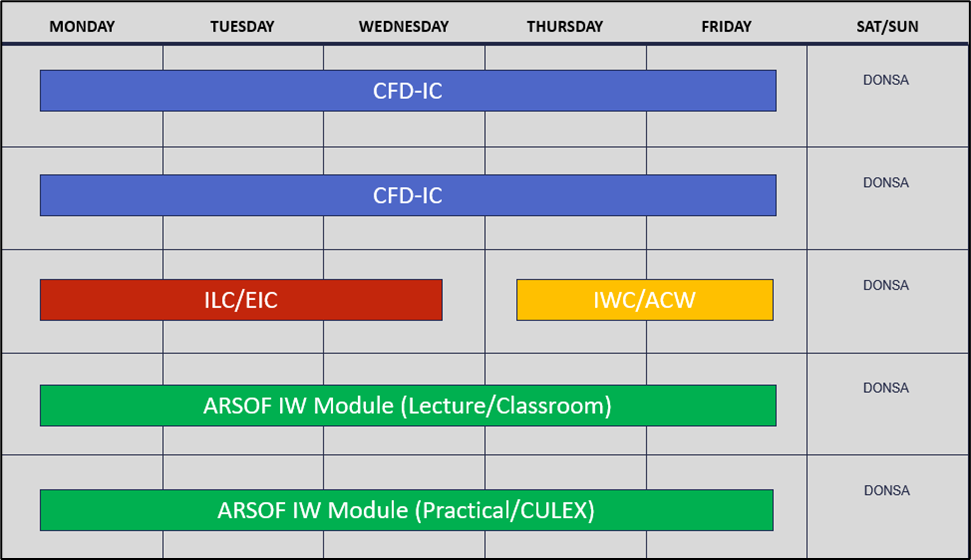
Figure 5. Example of proposed Irregular Warfare Instructor-Operator POI to incorporate into the post-graduation phase of the SFQC (Graphic provided by Dr. Daniel Ross).
Students complete CFD-IC during the first two weeks of the “Irregular Warfare Instructor-Operator” course. Realistically, all four workshops can be combined to be completed in a one-week POI during week three. Once CFD-IC and the instructional workshops are completed, students then spend the remaining two weeks learning foundational knowledge about their new profession as SF operators. Weeks four and five encompass an ARSOF Irregular Warfare Module similar to the UW POI in SLC and the ‘ARSOF Module’ in the Special Forces Warrant Officer Technical and Tactical Certification Course (SFWOTTCC). Week four includes a classroom-based introduction to irregular warfare, covering where the SF principal tasks intersect with named irregular warfare activities. The final week incorporates practical exercises in which students select and employ instructional strategies and various appropriately identified MOIs in UW or FID environments to instruct and train a PF.
The key benefit of this COA is that all Green Berets achieve instructor certification early on in their careers. This allows them to hone and practice their craft throughout their entire career, not just during their SWCS tour and beyond. Having already completed CFD-IC certification prior to arriving at SWCS, instructors can focus immediately on qualifying in their new, unique instructor assignment, rather than waiting to attend an upcoming course to become fully qualified. The COA further allows mid-career instructors to more quickly concentrate on earning their U.S. Army basic instructor badge, making it reasonably attainable to achieve their senior instructor badges during a three-year assignment at SWCS. Having already completed these courses, they can focus on brief instructor-refresher training, followed by more advanced workshops or seminars offered by the SFDD.
Additionally, having already attended all four of the listed initial workshops affords each Green Beret exposure to and experiential knowledge of instructional strategies and MOIs early in their career. Students in the SFQC would greatly benefit from having a cadre already exposed to instructor training, rather than having instructors learn “the ropes” during their first year of teaching. Incorporating this new POI into the post-graduation phase of the Q-Course, rather than during, reduces the potential for it to become a sunk financial cost if students do not successfully complete the SFQC. Finally, placing the course in the last phase of training also ensures that the introduction to irregular warfare remains fresh in students’ minds when they arrive at their SF Group.
Counter Arguments
The preceding argument emphasizes the inclusion of a new irregular warfare-based instructor POI in the SFQC to provide entry-level Green Berets with an understanding of instructional strategies and MOI from the outset of their careers. However, critics of this suggestion might highlight certain obstacles given the current operating environment. Adding an additional POI to the SFQC certainly produces time, resource, financial, and personnel burdens. Of course, the proposed COA must undergo a future comprehensive capabilities-based assessment and analysis of doctrine, organization, training, materiel, leadership and education, personnel, facilities, and policy (DOTMLPF-P) to rigorously assess the feasibility of mitigating the capability gaps identified in this article.
There may also be resistance by the current SFDD or key stakeholders at the Special Operations Center of Excellence (SOCoE) to undertake this proposed COA. Furthermore, the SF Regiment has recently faced significant shortfalls in recruiting and production.
74 Lengthening the SFQC may be the last thing on leaders’ minds, given the amplified focus on getting Green Berets to the force as quickly as possible. Though all valid concerns, solutions to these challenges exist. They merely require the appropriate strategic foresight, collaborative conversation, and deliberate adaptation to ensure that the SF Regiment lives up to its reputation as being wholly comprised of expert advisors and instructors.
Conclusion
The U.S. Army SF Regiment has an opportunity to make MOI a more prominent aspect of entry-level Green Berets’ education to help the organization remain competitive within the contemporary irregular warfare domain. The identified problem in this article is that aspiring Green Berets receive minimal instruction concerning MOI during the SFQC. The importance of MOI as an irregular warfare tool for the SF Regiment can be understood in two critical ways. First, providing aspiring Green Berets with a more robust understanding of how to pair instructional strategies with suggested MOIs enables them to serve as more effective instructors, teachers, and advisors across the full spectrum of irregular warfare activities. Second, certain MOIs are particularly well-suited to irregular warfare activities, and mastery of MOI equips SF advisors to develop cross-cultural competence, generate force-multiplying effects, sustain HN resistance and resilience, and reinforce the legitimacy and strategic influence of PFs. Finally, the article provides a clear COA for enhancing the SFQC, underscoring the centrality of instructional competence within the UW and FID core tasks that anchor the SF Regiment’s irregular warfare expertise. Ultimately, if the SF Regiment seeks to strengthen and maintain its mastery of irregular warfare, it must prioritize MOI and deliberately cultivate future advisors as highly effective instructors from the outset of their careers.
Author’s Note: Dr. Daniel W. Ross is a U.S. Army Special Forces Soldier with experience across multiple echelons of the 10th Special Forces Group (Airborne), including deployments to Africa, Ukraine, and Afghanistan. He teaches graduate courses concerning homeland security, homeland defense, and emergency and disaster management. His work has been published in ProQuest, Special Warfare Journal, Small Wars Journal, and the NCO Journal. He is the recent winner of the 2025 SOCoE Writing Contest at USAJFKSWCS. The view, opinions, and analysis expressed do not represent the position of the U.S. Army or the Department of War.
Endnotes
- U.S. Department of the Army, TRADOC Pamphlet 350-70-14: Training and Education Development in Support of the Institutional Domain (Fort Eustis, VA: U.S. Army Training and Doctrine Command, 15 April 2021), https://adminpubs.tradoc.army.mil/pamphlets/TP350-70-14.pdf
- Christopher Klein, “How Green Berets Became the U.S. Army’s Elite Special Forces,” History, November 7, 2023 (updated May 27, 2025), A&E Television Networks, https://www.history.com/articles/green-berets-armys-special-forces; FRONTLINE, “On the Ground — What Are the Special Forces?,” PBS, https://www.pbs.org/wgbh/pages/frontline/shows/campaign/ground/specialforces.html
- U.S. Department of the Army, Field Manual 3-18: Special Forces Operations (Washington, DC: U.S. Government Publishing Office, 2014), https://info.publicintelligence.net/USArmy-SF-Ops.pdf
- For more on the named missions and activities of IW, see: Catherine A. Theohary, Defense Primer: What Is Irregular Warfare?, CRS In Focus IF12565 (Washington, DC: Congressional Research Service, 29 November 2024), https://www.congress.gov/crs-product/IF12565
- U.S. Army, FM 3-18: Special Forces Operations.
- Thomas Williams, “An Evidence-Based Approach to Unit-Level Teaching and Learning,” Journal of Military Learning 4, no. 1 (April 2020): 57–67, https://www.armyupress.army.mil/Journals/Journal-of-Military-Learning/Journal-of-Military-Learning-Archives/April-2020/Williams-Evidence-Based/
- U.S. Army John F. Kennedy Special Warfare Center and School Public Affairs, “Robin Sage Exercise Set,” Army (July 7, 2015), https://www.army.mil/article/151795/robin_sage_exercise_set
- U.S. Army John F. Kennedy Special Warfare Center and School, USAJFKSWCS Newcomers’ Handbook, updated February 2023, https://www.swcs.mil/Portals/111/NewcomersGuide.pdf
- For more on the intersection of SF Principal Tasks and IW Activities, see: U.S. Department of the Army, Field Manual 3-05: Army Special Operations (Washington, DC: U.S. Government Publishing Office, June 2025), https://armypubs.army.mil/epubs/DR_pubs/DR_a/ARN44116-FM_3-05-000-WEB-1.pdf
- Daniel W. Henk and Allison Abbe, “Restoring Priority on Cultural Skill Sets for Modern Military Professionals,” Parameters 54, no. 3 (August 26, 2024): doi:10.55540/0031-1723.3304, https://publications.armywarcollege.edu/News/Display/Article/3890298/restoring-priority-on-cultural-skill-sets-for-modern-military-professionals/
- Russell D. Howard, Greta Hanson, and Carly Laywell, Cultural Intelligence for Special Forces Personnel, JSOU Report 16-10 (MacDill Air Force Base, FL: Joint Special Operations University Press, 2016), https://www.govinfo.gov/content/pkg/GOVPUB-D-PURL-gpo81281/pdf/GOVPUB-D-PURL-gpo81281.pdf
- Stavros Atlamazoglou, “Inside the Secretive Training That U.S. Green Berets Give to Troops Who May Have to Take on Russia or China,” Business Insider, January 19, 2022, https://www.businessinsider.com/foreign-internal-defense-us-troops-train-partners-to-fight-rivals-2022-1
- U.S. Army, FM 3-05: Army Special Operations.
- Michael K. Nagata, “The Power of Relationships and Partnerships Forged by Special Ops,” Military Times, May 8, 2024, https://www.militarytimes.com/opinion/2024/05/08/the-power-of-relationships-and-partnerships-forged-by-special-ops/
- Max Workentin, “Empowering Allies, Preventing Conflict: The Strategic Value of Foreign Internal Defense Missions,” Strategic Operations and Advisory Association (SOAA), August 21, 2024, https://soaa.org/foreign-internal-defense/
- U.S. Army, FM 3-05: Army Special Operations.
- Seth G. Jones, “The Role of Special Operations Forces in Great Power Competition,” Center for Strategic and International Studies, February 8, 2023, https://www.csis.org/analysis/role-special-operations-forces-great-power-competition
- Spencer B. Meredith III, “Building Strategic Lethality: Special Operations Models for Joint Force Learning and Leader Development,” Joint Force Quarterly 118, no. 3 (3rd Quarter 2025): 30–41, https://digitalcommons.ndu.edu/joint-force-quarterly/vol118/iss3/6
- “US Green Berets Who’ve Trained Taiwanese Troops Explain How They Could Fight China and Why the US Keeps Their Mission Secret,” Business Insider, October 24, 2021, https://www.businessinsider.com/us-green-berets-explain-how-they-train-taiwan-troops-2021-10
- John Bauer, “Legitimacy in Irregular Warfare,” Military Review (July–August 2009), 99–101, https://www.armyupress.army.mil/Portals/7/military-review/Archives/English/MilitaryReview_20090831_art016.pdf
- Christian Trotti, “A New Playbook for Irregular Warfare: How the United States Can Win Without Fighting,” Small Wars Journal, May 28, 2025, https://smallwarsjournal.com/2025/05/28/winning-without-fighting-irregular-warfare-strategy
- U.S. Department of Defense, Joint Publication 3-22: Foreign Internal Defense (Washington, DC: The Joint Staff, July 12, 2010), https://irp.fas.org/doddir/dod/jp3_22.pdf
- Elizabeth M. Collins, “A Green Beret Reflects on Necessity of Strong Relationships with Local Allies,” U.S. Army, November 17, 2016, https://www.army.mil/article/178409/a_green_beret_reflects_on_necessity_of_strong_relationships_with_local_allies; David Walton and Joseph Long, “Green Berets: Rebuilding the Guerrilla Leader Identity,” Small Wars Journal, February 8, 2019, https://archive.smallwarsjournal.com/index.php/jrnl/art/green-berets-rebuilding-guerrilla-leader-identity
- U.S. Department of the Army, TRADOC Regulation 350-70: Army Learning Policy and Systems (Fort Eustis, VA: U.S. Army Training and Doctrine Command, 10 July 2017), https://adminpubs.tradoc.army.mil/regulations/TR350-70.pdf
- U.S. Department of the Army, TRADOC Pamphlet 350-70-14: Training and Education Development in Support of the Institutional Domain.
- Ibid.
- Robert J. Pleban et al., Comparison of Direct Instruction and Problem-Centered Instruction for Army Institutional Training, Defense Technical Information Center Report ADA 578566 (Alexandria, VA: Defense Technical Information Center, April 2013), https://apps.dtic.mil/sti/pdfs/ADA578566.pdf
- U.S. Department of the Army, TRADOC Pamphlet 350-70-14: Training and Education Development in Support of the Institutional Domain.
- Ibid.
- Army Credentialing Opportunities On-Line (COOL), Department of Defense, https://www.cool.osd.mil/army/index.html
- U.S. Department of the Army, TRADOC Pamphlet 350-70-14: Training and Education Development in Support of the Institutional Domain.
- Ibid.
- Rebecca Lynne Towle Strawn, Implementing the Army University Experiential Learning Model: A Case Study of Instructors’ Experiences (EdD diss., University of Memphis, 2022), https://digitalcommons.memphis.edu/etd/3275/
- Henry Leung, Examining the Army Learning Model: Case Study (EdD diss., Creighton University, Omaha, NE, 2017), https://researchworks.creighton.edu/esploro/outputs/doctoral/Examining-the-Army-Learning-Model-Case/991005932353702656
- “U.S. ‘Partner Choice’ with Indo-Pacific Partners,” Association of the United States Army, July 12, 2019, https://www.ausa.org/news/us-%E2%80%98partner-choice%E2%80%99-indo-pacific-partners; Paul Burton, “The Three Pillars of Irregular Warfare Education,” Special Warfare Journal, November 15, 2024, https://www.swcs.mil/Special-Warfare-Journal/Article/3965910/the-three-pillars-of-irregular-warfare-education/
- U.S. Department of the Army, TC 18-02 Special Forces Advisor Guide (Washington, DC: U.S. Government Publishing Office, 2022), https://armypubs.army.mil/ProductMaps/PubForm/Details.aspx?PUB_ID=1024697
- U.S. Army John F. Kennedy Special Warfare Center and School, https://www.swcs.mil/
- U.S. Department of the Army, TRADOC Pamphlet 350-70-14: Training and Education Development in Support of the Institutional Domain.
- U.S. Department of the Army, TC 3-21.76: Ranger Handbook (Washington, DC: Department of the Army, September 2025).
- Joshua Skovlund, “How Well Do You Know the Army’s 14 Battle Drills?” Task & Purpose, January 9, 2024, https://taskandpurpose.com/military-life/us-army-battle-drills/
- Maj. Mark Thomas, Maj. Brian Graham, and Maj. Nathan Freeman, “Warfighting Partners: Integrating Unique Units Into I Corps Training, Exercises,” Association of the United States Army, July 24, 2025, https://www.ausa.org/articles/warfighting-partners-integrating-unique-units-i-corps-training-exercises
- Stavros Atlamazoglou, “Inside the Secretive Training That U.S. Green Berets Give to Troops Who May Have to Take on Russia or China.”
- U.S. Department of Defense, Joint Publication 3-25: Countering Threat Networks (Washington, DC: The Joint Staff, December 21, 2016), https://irp.fas.org/doddir/dod/jp3_25.pdf
- For more on TLPs, see: Fredrick Heard, “Planning and Troop Leading Procedures,” NCO Journal, 536th Brigade Support Battalion, November 20, 2019, https://www.armyupress.army.mil/Journals/NCO-Journal/Archives/2019/November/Troop-Leading-Procedures/
- Isaac J. Peltier, Surrogate Warfare: The Role of U.S. Army Special Forces (Fort Leavenworth, KS: School of Advanced Military Studies, U.S. Army Command and General Staff College, Academic Year 2004–2005).
- U.S. Department of the Army, TRADOC Pamphlet 350-70-14: Training and Education Development in Support of the Institutional Domain.
- Ibid.
- Norman M. Wade, BSS6: The Battle Staff SMARTbook, 6th Ed.: Plan, Prepare, Execute, & Assess Military Operations (Lightning Press, 2020)
- Steve Ferenzi, Christopher J. Hickey, and Christopher Hossfeld, “Overmatch by Other Means: Integrating Irregular Warfare into Joint Force Wargaming,” Military Times, July 29, 2021, https://www.militarytimes.com/opinion/commentary/2021/07/29/overmatch-by-other-means-integrating-irregular-warfare-into-joint-force-wargaming/
- Ibid.
- Todd Greentree and Craig Whiteside, “Teaching for Irregular Warfare Competencies,” War Room – U.S. Army War College, October 25, 2024, https://warroom.armywarcollege.edu/articles/competencies-4/
- Chris Cruden and Doug Livermore, “OSS 2.0: Emphasizing the Importance of Human Intelligence in Irregular Warfare for Great Power Competition,” Irregular Warfare Center Perspectives, January 8, 2025, https://irregularwarfarecenter.org/publications/perspectives/oss-2-0-emphasizing-the-importance-of-human-intelligence-in-irregular-warfare-for-great-power-competition/
- For more on JCETs, see: Evan Cooper, “10th SFG (A) Participate in Joint Combined Exchange Training,” Army.mil, March 20, 2024, https://www.army.mil/article/274675/10th_sfg_a_participate_in_joint_combined_exchange_training
- Richard Fetters, Brigid Hickman, Ryan Jones, and Josh Reed, “Winning the First Fight: Experimenting With Army Special Operations Forces’ Contributions in Large-Scale Combat Operations,” Modern War Institute at West Point, August 9, 2024, https://mwi.westpoint.edu/winning-the-first-fight-experimenting-with-army-special-operations-forces-contributions-in-large-scale-combat-operations/
- Symposium example: Indo-Pacific Irregular Warfare Symposium – SOF Partnerships, https://gsofindopacific.org/
- See: David Kilcullen, “The Evolution of Unconventional Warfare,” Scandinavian Journal of Military Studies 2, no. 1 (2019): 61–71, https://doi.org/10.31374/sjms.35
- U.S. Department of the Army, TRADOC Pamphlet 350-70-14: Training and Education Development in Support of the Institutional Domain.
- Ibid.
- Paul Burton, “The Three Pillars of Irregular Warfare Education,”
- Leo Blanken, Philip Swintek, and Justin Davis, “Special Operations as an Innovation Laboratory,” War on the Rocks, February 25, 2020, https://warontherocks.com/2020/02/special-operations-as-an-innovation-laboratory/
- U.S. Army, FM 3-05: Army Special Operations.
- For more on Staff Rides, see: Liam Collins and Lionel Beehner, “A Leader’s Guide to Conducting Staff Rides,” Modern War Institute at West Point, August 18, 2020, https://mwi.westpoint.edu/a-leaders-guide-to-conducting-staff-rides/; Lionel Beehner and Liam Collins, “A Staff Ride for the Modern Battlefield,” Journal of Military Learning, April 2018, https://www.armyupress.army.mil/Journals/Journal-of-Military-Learning/Journal-of-Military-Learning-Archives/April-2018-Edition/Staff-Ride/
- Joseph L. Votel, “Military Gaming to Stay Ahead, But Not the Kind You Think,” War on the Rocks, August 29, 2025, https://warontherocks.com/2025/08/military-gaming-to-stay-ahead-but-not-the-kind-you-think/
- Trent D. Frum and Jared Stallone, “Applying Patrolling Principles to Large Scale Combat Operations at National Training Center,” Army.mil, February 10, 2025, https://www.army.mil/article/282951/applying_patrolling_principles_to_large_scale_combat_operations_at_national_training_center
- For an example of creating an Army guerrilla command and the use of practical exercises, see: Michael E. Krivdo, PhD, “Creating an Army Guerrilla Command, Part 1: The First Six Months,” Veritas 8, no. 2 (2012), https://arsof-history.org/articles/v8n2_guerrilla_command1_page_1.html
- U.S. Army John F. Kennedy Special Warfare Center and School Public Affairs, “Robin Sage Exercise Set.”
- Steve Beynon, “Meet the Guardsman Helping Ukrainians Blow Russian Tanks Over the Phone,” Military.com, June 3, 2022, https://www.military.com/daily-news/2022/06/03/meet-guardsman-helping-ukrainians-blow-russian-tanks-over-phone.html
- Lisa Brown, “Storytelling as an Instructional Technique: Recommendations for Military Instructors,” Journal of Military Learning 8, no. 1 (April 2025): 55–71, https://www.armyupress.army.mil/Journals/Journal-of-Military-Learning/Journal-of-Military-Learning-Archives/JML-April-2025/Storytelling/
- U.S. Department of the Army, TRADOC Pamphlet 350-70-14: Training and Education Development in Support of the Institutional Domain.
- U.S. Army, FM 3-18: Special Forces Operations.
- See: USAJFKSWCS SFDD’s informational pamphlet produced by the Literature Development Division.
- For more on the USAJFKSWCS, see: U.S. Army, “John F. Kennedy Special Warfare Center and School,” Military.com, December 04, 2013, https://www.military.com/special-operations/john-f-kennedy-special-warfare-center-and-school.html
- U.S. Army NCO Leadership Center of Excellence, “Common Faculty Development Instructor Course,” https://www.ncoworldwide.army.mil/Academics/NCO-Academies/Henry-H-Lind-NCO-Academy/Common-Faculty-Development-Instructor-Course/
- Pete Guerdan, Jim Maicke, and Jonathan Mleynek, “Operators Wanted: SORB—Navigating the Recruiting Challenges Facing the Army,” Special Warfare Journal, U.S. Army John F. Kennedy Special Warfare Center and School, March 20, 2025, https://www.swcs.mil/Special-Warfare-Journal/Article/4130022/operators-wanted-sorb-navigating-the-recruiting-challenges-facing-the-army/