Introduction
Not long after open-source reporting on Operation ABSOLUTE RESOLVE (OAR) broke, to include the article “The Medvedev Corollary” shared by the 1st Special Forces Command (Airborne) Commanding General, our soldiers began dissecting the operation. They discussed the implications for Special Forces (SF) deep operations in large-scale combat operations (LSCO). During a battalion forum, an 18-series Soldier raised a concern he and his team had been pondering. They had trained for infiltration and target development against integrated air defense systems (IADS) components, and enabling joint strikes, assuming air access would be contested or denied. Yet OAR showed that the U.S. could rapidly defeat air defenses through integrated air, cyber, and electronic warfare assets, leveraging a joint conventional force (CF) and special operations force (SOF) force package.
01 The follow-up question was blunt: If this can be done without SF, what exactly is SF’s mission in LSCO?
Simply put, if the joint force can, at times, penetrate anti-access / area denial (A2/AD) systems, how does that affect the necessity and purpose of SF deep operations in LSCO? What elements remain essential to SF’s mission?
Purpose
This white paper examines how Operation ABSOLUTE RESOLVE impacts the role of Special Forces in LSCO. It asks: What, if anything, truly shifts about SF’s mission set and necessity when the joint force can defeat integrated air defenses? It further identifies the conditions where SF deep operations remain critical, despite advances in A2/AD defeat by the broader joint force.
Scope
This paper focuses on SF deep operations in LSCO as they relate to enabling the main battle area. It does not address steady-state competition or crisis response, nor does it examine peripheral operations or operations intended to open new fronts (e.g., Task Force Viking), though both remain critical.
Key Insights
The following key insights frame the analysis and inform recommendations:
Scalability: OAR is neither routine nor scalable in LSCO; massed, highly integrated national-level effects will be allocated infrequently and at high-opportunity cost.
Framing: In LSCO, SF’s relevant frame is enabling the supported corps / division deep fight.
02 The ground CF commander is primarily concerned with preventing effective enemy employment in the close area by shaping when, where, and in what condition the enemy can commit combat power.
03 Therefore, SF deep operations should be framed around enabling the supported commander’s close fight, not anchored on national-level targets.
Target Serviceability Drives the SF Requirement: The enduring need for SF deep operations in LSCO hinges less on A2/AD penetration and more on which targets can be reliably prosecuted. Corps / division commanders prioritize and allocate limited deep fires and aviation under constraints (time, mobility, rules of engagement, collateral risk, prioritization). SF adds the most value where constraints prevent reliable prosecution by other means.
Strategic Effect is Cumulative: SF’s strategic value in LSCO is persistent pressure and delay that shape the close fight and prevent effective enemy employment over time, rather than a single decisive raid.
Operation ABSOLUTE RESOLVE: Why It’s Not the LSCO Model and What it Might Change
Assuming that the capabilities described in “The Medvedev Corollary” are factual, OAR’s force package reflected an exceptional concentration of national-level capabilities and preparation. The article notes that the operation involved “over 150 aircraft launched simultaneously from 20 locations across the Western Hemisphere” and that the cyber access enabling the air defense collapse was “likely established months before the kinetic operation.”
01
These two details are the core reason that the operation should not be treated as a repeatable LSCO model for the majority of SF’s likely mission sets. A peer LSCO fight demands simultaneous deep effects over a much broader battlespace, and for sustained periods. Even if technically possible, such asset allocation and months of preparation cannot be routinely replicated while supporting a corps or division-scale campaign that requires continuous targeting, shaping, and protection across depth.
Stated plainly: OAR demonstrates what is possible when the joint force can assemble a unique combination of time, access, mass, and integration. LSCO, however, typically lack those conditions at scale.
What might change: while OAR is not a scalable LSCO model, it may still shape how we think about LSCO in two ways. First, it suggests that the joint force can, under the right conditions, create rapid windows of access through A2/AD. Second, it could imply that SF should avoid anchoring their target focus on A2/AD systems alone. As covered in a recent RUSI Insight Paper, “Emergent Approaches to Combined Arms Manoeuvre in Ukraine,” SF could be uniquely postured to provide a strategic advantage to the close fight by focusing on deep area war-sustaining targets that drive the enemy’s ability to commit and sustain combat power—particularly reserves, logistics nodes, and industrial targets.
04
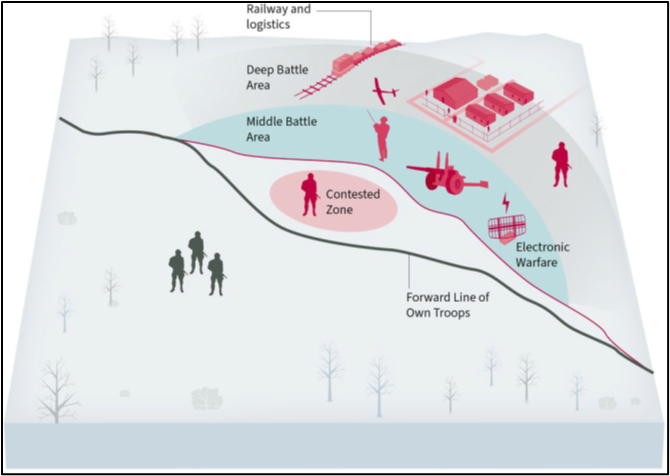 Figure 1: Ukrainian Battlefield Geometry, Source: Watling, Emergent Approaches to Combined Arms Manoevre in Ukraine, 2025. Graphic design: Alex Whitworth Art & Design.04
As the author notes, unmanned aerial vehicle and artillery capacity are heavily consumed in the contested zone and ‘middle battle area,’ where reconnaissance and ‘middle-strike’ effects are concentrated to isolate close objectives.
04 In LSCO, the joint force will likely prioritize scarce intelligence, surveillance, and reconnaissance (ISR) assets and fires assets in similar fashion, leaving war-sustaining nodes of the deep areas less reliably prosecuted by standoff means. This gap is a natural lane for SF deep operations. These service support areas are also likely to sit in and around population centers and civil infrastructure, where target discrimination becomes all the more important.
Where SF Deep Operations Matter
SF deep operations matter most where high-payoff deep targets are not reliably serviced by fires or aviation alone. This 'gap' is clearest in the enemy’s logistics support zone—the deep area enabling sustainment, movement control, reserves, and repairs. With priority ISR, fires, and aviation consumed elsewhere, these nodes are less reliably targeted but often determine if enemy formations arrive, refit, and fight as planned.
The enemy logistics support areas (e.g., Corps Support Area, Division Support Area, etc.) are ideal for SF deep operations, as they are where disruption most directly shapes the enemy’s ability to commit combat power and where other means are least reliable. SF deep operations should focus on shaping when, where, and in what condition the enemy can commit combat power.
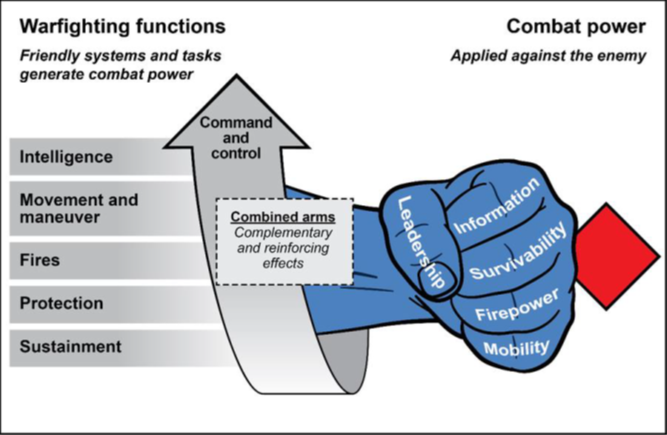 Figure 2: Generating Combat Power, Source: ADP 3-0, Operations05
The Army defines combat power as “the total means of destruction and disruptive force which a military unit / formation can apply against the opponent at a given time.”
05 If the enemy cannot move reserves, fuel formations, delivery ammunition, repair losses, or maintain command and control, it cannot commit combat power in usable conditions to the close fight.
This is the deep problem SF should own.
Within that problem set, SF is thus uniquely suited to enable effects against three types of targets:
Targets Requiring Discrimination: SF deep operations are most relevant where the operational environment demands high discrimination, especially in and around population centers, where collateral risk may limit the use of massed fires and aviation. This also includes targets where the effect required does not justify expensive munitions but still matters operationally when applied repeatedly at scale.
War-Sustaining Systems: SF deep operations are uniquely suited to pressure the enemy’s ability to commit and sustain combat power by focusing on lines of communication, logistics nodes, repair capacity, and select industrial infrastructure. Effects against these targets delay and disrupt an enemy’s timing, tempo, and sustainment of the close fight.
Targets that are Hard to Find, Fix, or Hold: SF adds disproportionate value against mobile or time-sensitive targets because teams can get eyes on, maintain contact, and cue strikes when windows open. Without persistent contact, these targets often displace before fires or aviation can be applied.
Taken together, this is consistent with SF’s historical role as an “economy of force [element] employed to delay, disrupt, or harass hostile reinforcing forces or divert them to secondary areas of operations to later the momentum and tempo of hostile operations,” and one not “structured for attrition or force-on-force warfare.”
03
Our guerrilla operations history provides useful operating logic for LSCO deep operations: small, mobile forces who can create outsized, cumulative effects against a numerically superior force. Accordingly, SF deep operations should—
- Emphasize “preservation of their military forces and attack at points most disadvantageous to the enemy.”06
- Direct attacks “against isolated outposts, weakly defended locations, or enemy patrols.”06
- Raids should follow conventional raid principles “with additional emphasis on ensuring surprise and survivability of the raiding force.”06
Recommendations
These recommendations translate the paper’s key insights into potential changes to how detachments train and prepare for their wartime mission.
1. LSCO Exercise Redesign: Use LSCO-focused exercises to reflect the deep fight of an enemy logistics support zone. This means population centers, civilian patterns, infrastructure rather than a “no man’s land” deep area dominated by IADS and other fires assets. Build the exercise around war-sustaining systems (e.g., fuel, ammo, maintenance, movement control, communications nodes, rail, and road infrastructure) and untasked reserve forces.
2. Training Guidance Adjustments: Evaluate advanced operations bases (AOBs) / operational detachments – bravo (ODBs) on how they employ their operational detachments – alpha (ODAs) to generate cumulative effects. AOBs should be evaluated while managing their ODAs signature and survivability across the deep fight over time, not just primarily on singular, consolidated decisive actions. Evaluate ODAs on their ability to move decentralized to an objective area, control their electromagnetic spectrum signature, and displace rapidly after going kinetic. Equally incentivize SF detachments to achieve effects through standoff or delayed effects that reduce exposure and preserve the force. For raids, shift evaluations towards movement to the objective, signature management, and survivable exfil. Make survivability a first-order task that must be trained.
3. Increase Targeting Literacy and Sustainment Architecture Analysis: Build a deeper understanding of corps and division deep targeting and enemy sustainment architecture as the primary LSCO problem set. Train staffs and detachments to understand how supported commanders prioritize targets and allocate limited deep fires and aviation assets. Develop a standard framework for analyzing enemy support zones and sustainment networks: What enables the close fight, where the system is vulnerable, which nodes are high payoff. Use that framework to drive detachment mission planning and operational design and target selection.
Closing
Operation ABSOLUTE RESOLVE does not invalidate SF deep operations—it clarifies the difference between what is possible and what is repeatable at scale. In LSCO, SF’s value is not a single decisive raid; it is the persistent, survivable disruption and discrimination against targets that shape when, where, and in what conditions the enemy can commit combat power. Implementing the changes above will better align training and evaluation with the targets and constraints we should expect in a corps or division deep fight.
Author’s Note: Major Bryan King is a career Regular Army Soldier and Special Forces Officer with more than 13 years of service. He currently serves as an Executive Officer for a Special Forces Battalion. The views, opinions, and analysis expressed do not represent those of the U.S. Army or the Department of War.
References:
01 Perera, Shanaka Anslem. 2026.
The Medvedev Corollary: How 150 Minutes Over Caracas Reworte the Physics of Global Power and Triggered the Second Nuclear Age. January 4. https://substack.com/home/post/p-183428226.
02 U.S. Department of the Army,
Deep Operations, ATP 3-94.2. Washington, DC: Department of the Army, 01 September 2016.
03 U.S. Department of the Army,
Army Special Operations, FM 3-05. Washington, DC: Department of the Army, 2025.
04 Watling, Jack. 2025.
Emergent Approaches to Combined Arms Manoeuvre in Ukraine. Insights Papers, Whitehall, London: RUSI. https://www.rusi.org/explore-our-research/publications/insights-papers/emergent-approaches-combined-arms-manoeuvre-ukraine.
05 U.S. Department of the Army,
Operations, ADP 3-0. Washington, DC: Department of the Army, March 2025.
06 U.S. Department of the Army,
Special Forces Unconventional Warfare, ATP 3-18.4. Washington, DC: Department of the Army, June 2025.