Editor’s Note: This is the first time that this story has been documented from the U.S. side. The Soldiers in this story were never recognized for their actions; they did it selflessly because it was the right thing to do. This historical vignette is applicable to every Army Special Operations Forces (ARSOF) Soldier in our formation, especially as members of the Army’s premier partner force.2009, Colombia. It was a hot August morning at the International Police Training School of Colombia (CENOP) in Tolima. The last thing we expected was that we would soon be surrounded by a blazing inferno as we prepared to conduct a graduation ceremony for a class of Colombian Carabinero Police Officers. Over the three weeks prior, we conducted an assessment and selection course for our Carabinero partners, and this was the day they would receive their U.S. Special Forces foreign training insignia. But in less than an hour after we set up the venue, we were battling 15-foot-high flames, breathing in thick smoke and ash, burning our boots and uniforms, and coughing out dark black soot.
That day, a severe wildfire hit the Tolima area during a harsh dry season that left the region primed for disaster. The massive flames – fueled by the wind and extreme heat – burned through forests and farmland, putting homes, families, water supplies, training areas, an ammunition supply point (ASP), and other critical infrastructure at risk. The CENOP base stood in the fire’s path. Our small U.S. Special Forces split team (Green Berets from ODA 736) mobilized fast as the dangerous situation demanded immediate action. We pivoted from the graduation ceremony and took our graduating students (Carabineros) to rapidly shift into firefighting assessments and task organization. As ARSOF Soldiers, our initial focus was to save lives, contain the rapidly approaching fire, and protect the base’s infrastructure alongside our partners.
Our small group of Green Berets linked up with our Colombian partners, and we jumped into firefighting action without hesitation. One of the SF NCOs contacted our leadership via cellphone, who then relayed it to the U.S. Embassy in Bogotá. With notifications made, the three of us on the ground quickly organized into firebreak teams and began clearing flammable vegetation around vital structures to prevent the fire from destroying the base. We grabbed every available tool: shovels, picks, sandbags, water buckets, portable sprayers, and whatever else was available to create barriers to stop the advancing flames. Several of our partners were designated to spot wind shifts and identify new flare-ups in the surrounding mountains and hills, while our frontline firefighting teams coordinated the rapid construction of firebreaks.
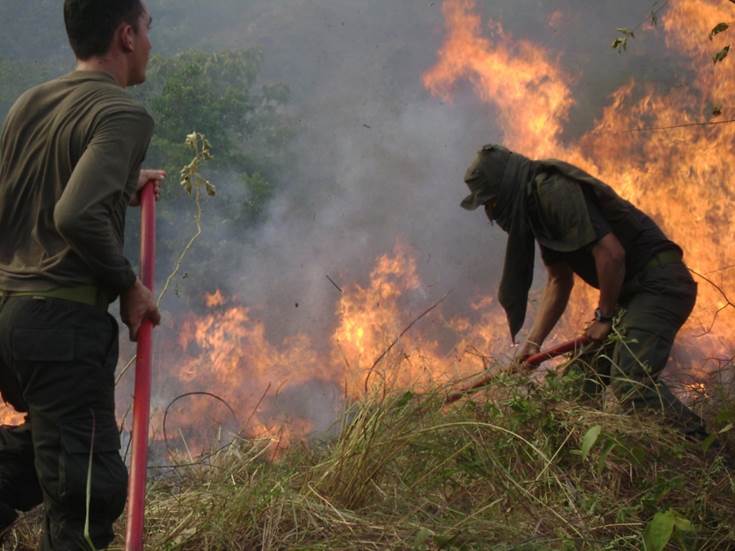 Colombian National Police work quickly to build an expedient fire break, as the flames rapidly engulf the training area. Photo courtesy of Sergeant Major Treviño.
Thick smoke and falling ash made it incredibly hard to breathe and see. It was intense and dangerous, but we kept pushing through as the fire raged, destroying more than 150 acres. The fire put water systems and crops at risk, leaving thousands worried about basic needs. On the ground, we fought the flames directly, building numerous firebreaks (often within inches of towering flames), evacuating people, and protecting vital infrastructure. The heat was intense, hindering our crews as we worked just a few feet from fast-moving fire lines and huge flames. The dangers of working the fire line were constant: Shifting winds, fast flames, and oppressive heat made conditions unpredictable, but our team was right in the middle of it. The Colombian and U.S. ad-hoc firefighters worked shoulder to shoulder, drenched in soot and sweat as we cleared brush and dug firebreaks. The risk of severe burns, heat exhaustion, and even death was constant. To this day, many of us still have breathing issues from this incident.
One of the most critical moments came when we were alerted to a dangerous flare-up that was quickly approaching the ASP. With the fire spreading rapidly, flames came dangerously close—less than 10 feet from the ASP’s Conex containers. Inside, there were thousands of rounds of pistol, rifle, and belt-fed ammunition, along with C4, demolition charges, and other high explosives. Evacuating the ASP was incredibly risky, but we quickly put together a team of volunteer police officers, knowing that failure would mean catastrophic consequences. Had we not acted swiftly, the fire would have set off the rounds in the ASP. We moved quickly and decisively to evacuate the two Conex containers, all while being surrounded on three sides by fast-moving flames, smoke, and ash. We shuttled all the ammo and explosives up to the top of the clearing in the middle of the base and left a guard, while the rest of us continued firefighting. These actions protected lives and prevented a disastrous explosion and loss of life.
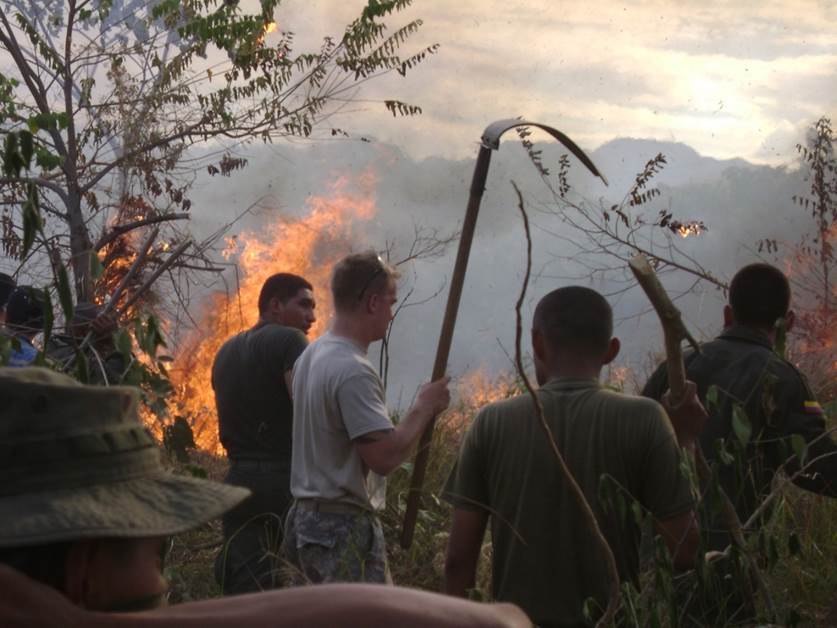 A Green Beret assists in building one of many expedient fire breaks around the CENOP training area. Photo by Sergeant Major Treviño.
The Colombian Air Force joined the fight and supported the firefighting efforts with Bell 212 helicopters, dropping water and fire retardant on the worst hotspots. This was critical to the overall operation, as much of the mountainous terrain was inaccessible by ground forces. Air and ground teams stayed in constant contact. While the helicopters worked above, police, Green Berets, and local crews tackled the flames directly—digging, cutting, and hauling equipment through stifling heat, flames, and thick smoke. Breathing was tough, exhaustion set in quickly, but we never quit. Stopping the fire was our only option.
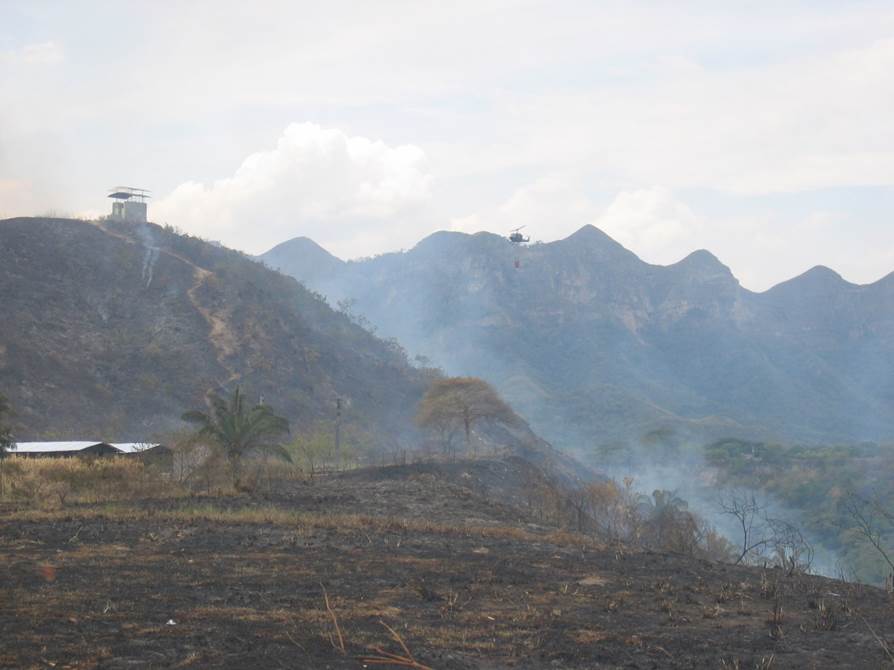 A Colombian Air Force Bell 212 prepares to drop water over a burning area on day 2 of the fire. Photo by author.
The blaze raged on into the night and the second day. By the time additional help arrived, the scale of the damage was staggering: Nearly 500 acres had been destroyed, and more than 5,000 people in local villages were impacted. The relief in the local villages was critical; if the Air Force helicopters and additional fire crews hadn’t shown up, the fires would have continued to sweep through the area and local towns. Once the fire was under control, attention shifted to the surrounding communities. Helicopter teams continued water drops while ground teams shored up gains from the previous day.
Even with all this destruction, we held fast. At the CENOP, not a single life was lost, which was a testament to the speed and efficiency of the volunteer emergency crews. As smaller fires continued to burn on the second day, crews continued their firefighting efforts. Without the local responder’s quick response time, things would have been far worse. The impromptu firefighters’ skill, selflessness, and bravery made all the difference, saving lives and infrastructure.
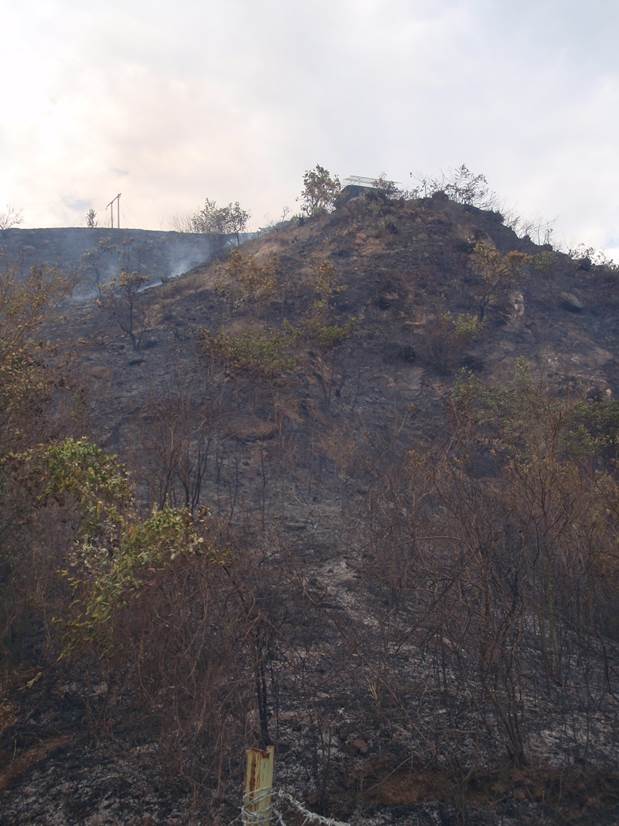 Part of the aftermath on day 2, showing a portion of the south side of the training area. Photo by author.
In the end, what truly stood out to me was the unwavering partnership and trust among the Colombian National Police, U.S. Special Forces, local firefighters, and air crews. Our teams didn’t just fight the intense, searing flames. We stood by each other, combining our skills and experience when every second mattered. It took grit, split-second decisions, and a deep sense of responsibility to protect the people and the local area. Each of us knew what was at stake, and nobody hesitated to step into danger for their teammates or the community. The professionalism and dedication on display went far beyond routine duty; it was a testament to how much can be accomplished when partners trust each other and work toward a common goal.
Thanks to fierce determination and seamless teamwork, what could have been a tragedy instead became a powerful example of partnership and courage in the face of disaster. For ARSOF Soldiers, the fire response revealed a critical aspect of ARSOF operations: the innate ability to support our partner forces in the most demanding conditions, without hesitation. Relationships, figuratively and literally, forged in fire.
Author’s Note: Chief Warrant Officer 4 William Bryant is a career Regular Army Soldier and Special Forces Officer with more than 24 years of service. He is a graduate of the School of Advanced Military Studies, How the Army Runs Course, and the Air Command and Staff College. He also holds three graduate degrees (MA, MS, and MA) and an FAA commercial pilot certificate, and he currently serves as a Battalion Senior Warrant Officer Advisor. The views, opinions, and analysis expressed do not represent the position of the U.S. Army or the Department of War.