Introduction
This article examines how Civil Affairs operates within the Civil-Military Coordination Center (CMCC) in Israel, highlighting the interplay with intergovernmental, international, and non-governmental organization (NGO) stakeholders. It underscores why understanding these dynamics are essential to effectively support humanitarian efforts and operational goals.
Civil Affairs is the Army’s primary capability for engaging in the civil aspects of the operational environment. Following the activation of the CMCC, Civil Affairs elements played a vital role in linking networks, creating and strengthening connections among various entities. This includes establishing early relationships among U.S. forces, host-nation representatives, humanitarian organizations, and other multinational stakeholders. By fostering these connections, Civil Affairs facilitated collaboration, enhanced communication, and ensured a coordinated approach to addressing stakeholders' needs and objectives.
Within weeks of the CMCC’s maturation, the operational landscape became saturated. Senior decision-making, resource allocation, and daily coordination increasingly moved under the purview of general officers, ambassadors, and high-ranking civilian directors. In this setting, Civil Affairs retains presence but not primacy—the Civil Affairs role has evolved from a coordinating hub to a subtle yet vital connective presence.
Understanding the Unique Operational Environment
The Israel–Gaza context presents significant challenges due to the absence of a direct U.S. military presence within Gaza. The reliance on contractors, NGOs, independent observers, and indirect sources of information complicates the operational landscape and requires deliberate Civil Affairs engagement across multiple channels. Regional and global variables impact the area, requiring continual monitoring and assessments. An initial assessment conducted in early November 2025 required reevaluation after the United Nations Security Council’s approval of Resolution 2803 on November 17, 2025.
This resolution endorsed President Trump’s comprehensive Peace Plan for Gaza, catalyzing increased participation by partner governments, intergovernmental organizations (IGOs), and NGOs. These organizations have demonstrated a deeper commitment to CMCC processes, further underscoring the importance of developing robust civil networks, sustaining atmospherics, and leveraging relationships to generate actionable civil understanding. The integration of civil knowledge into operations is vital, as Civil Affairs remains the military’s integrator of the civil dimension—ensuring leaders are informed about civil expertise, civil networks, and the emerging dynamics that affect humanitarian and security outcomes.
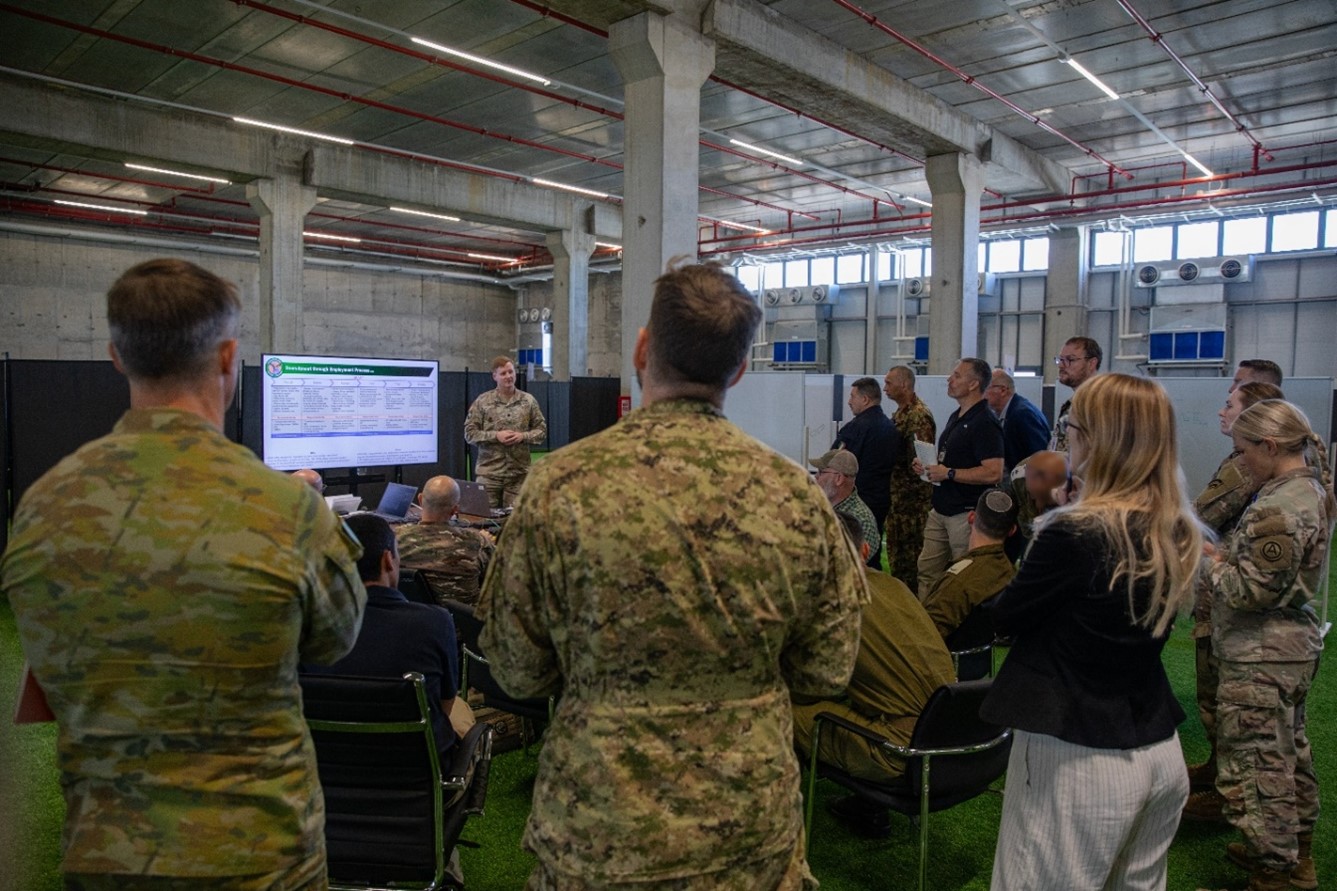 U.S. Army Soldiers assigned to U.S. Army Central, multinational armed forces, and representatives of Non-Government Organizations (NGO) attend a briefing inside the Civil-Military Coordination Center (CMCC) on Nov. 23, 2025, in Israel. The CMCC is designed to facilitate the flow of humanitarian, logistical, and security assistance into Gaza and monitors the implementation of the ceasefire agreement and the transition to civilian governance. (U.S. Army photo by Sgt. Aiden Griffitts
)
Situational Analysis & Ground Engagement Network (SAGE-NET)
To better operate in a non-permissive environment such as Gaza, I recommend establishing the SAGE-NET framework. The SAGE-NET—Situational Analysis & Ground Engagement Network—emphasizes systematic network mapping, atmospheric collection, and civil terrain analysis to anticipate future operational requirements. The SAGE-NET is intended as a forward-looking structure designed to: map civil influence networks; understand decision-making hierarchies on the ground; develop civil terrain approximations through proxy reporting; organize atmospherics by region, community, and theme; and prepare a baseline for future operational access should conditions change.
Preparing the civil landscape proactively improves command readiness, strengthens interagency coordination, and positions Civil Affairs to navigate the complex web of interests and agendas present in the CMCC.
Enhancing Information-Sharing Mechanisms
Improving information-sharing systems remains a central requirement for effective civil-military coordination. To do this, the U.S. military must explore commercial solutions capable of offloading Army Cyber or Department of War products into accessible, secure commercial platforms. The CMCC currently operates under a framework designed for unclassified data sharing among the U.S. and partner organizations. This system integrates data from various working groups operating under the Gaza ceasefire agreement, enabling collaboration with partner nations, IGOs, and NGOs.
To optimize this system or any similar platform, the U.S. should establish contractual mechanisms enabling seamless data sharing while maintaining security standards. Additionally, streamlining the intake of digital information from non-U.S. entities would significantly enhance situational awareness, particularly in monitoring humanitarian operations, community impact, and progress on the 20-point plan. Internal information-sharing gaps—particularly between Special Operations Forces (SOF) and non-SOF elements—should also be addressed to ensure unified understanding across the force.


 Trucks carrying humanitarian aid are staged at the Zikim Crossing Point on Nov. 25, 2025, in Israel. The U.S. is working with the international community to facilitate the flow of humanitarian assistance to civilians in Gaza. (U.S. Army photo by Staff Sgt. Mike Ito)
Technological Integration and Persistent Training
Trucks carrying humanitarian aid are staged at the Zikim Crossing Point on Nov. 25, 2025, in Israel. The U.S. is working with the international community to facilitate the flow of humanitarian assistance to civilians in Gaza. (U.S. Army photo by Staff Sgt. Mike Ito)
Technological Integration and Persistent Training
U.S. Central Command (USCENTCOM) and U.S. Army Central (USARCENT) are accelerating the formation of innovative teams to onboard emerging commercial technologies. Despite the abundance of tools—commercial off-the-shelf, government off-the-shelf (GOTS), and SOF innovation kits—Civil Affairs continues to face challenges in effectively adopting, retaining, and operationalizing these technologies.
Persistent training, long-term sustainment plans, and a clear operationalization pathway are required. Without sustained investment, Civil Affairs risks falling behind organizations that already specialize in these capabilities. Technology must be accompanied by training pipelines, employment concepts, and accountability structures that ensure continuity despite personnel turnover.
Developing Civil Environment Snapshots
Developing and disseminating civil environment snapshots for senior leaders within USARCENT and USCENTCOM is essential. Other units play a significant role in collecting humanitarian assistance distribution data; however, detailed visibility on civil dynamics, civil influence networks, and ground-level decision-making remains limited. This information typically emerges from: personal narratives, observational reporting, proxy sources, NGO or IGO assessments, and third-party monitors.
Verifying this data is inherently difficult, as multiple perspectives may all be correct depending on their vantage point. Civil governance structures, local decision-makers, and influence networks in Gaza vary significantly by location and controlling authority. Because Civil Affairs is no longer physically present, the ability to triangulate and validate civil information is further constrained, increasing the risk of assumptions entering the planning and operations process.
Even indirect snapshots of the civil environment can help identify potential influencers or friction points near humanitarian distribution nodes. Snapshots can also address surface community-level concerns, provide context to operational or diplomatic decisions, and bridge tactical humanitarian reporting with strategic communication requirements. While Civil Affairs cannot confirm every detail without being on the ground, it can still provide value by synthesizing perspectives, highlighting discrepancies, and presenting commanders with the most accurate civil approximation available.
Addressing Civilian Harm Mitigation and Response
Civilian harm mitigation and response (CHMR) remains a critical consideration, even in a highly constrained operational environment. Civil Affairs does not serve as the primary proponent for CHMR, but it does provide significant and direct support through:
- Understanding the civilian environment: Civil Affairs can contextualize population behavior, community expectations, and second-order effects of military or humanitarian actions.
- Data collection and reporting: Civil Affairs can collect atmospherics, document civil patterns, and relay emerging concerns from partner organizations or proxy networks.
- Integration and coordination: Civil Affairs can help align humanitarian actors, military elements, and civil governance authorities by synchronizing and deconflicting information.
- Training and education: Civil Affairs can support awareness efforts, helping units understand civilian considerations and minimize inadvertent harm.
Challenges include limited physical access to Gaza, reliance on second-hand information, conflicting reporting from humanitarian actors, heavy operational tempo within the CMCC, and difficulty validating or cross-checking information. However, opportunities include developing proxy-based civil sensors—formalized reporting of NGOs, IGOs, and partner nations—to identify lightweight risk indicators. Civil Affairs can propose simple, low-burden risk indicators of civilian harm to help commanders understand when local conditions may be shifting. These contributions help maintain humanitarian credibility and operational legitimacy without overstating Civil Affairs’ formal CHMR authorities.
Conclusion
The integration of Civil Affairs within the CMCC remains an evolving and adaptive process. Despite personnel reductions and the absence of Civil Affairs teams on the ground, meaningful contributions can still be made through deliberate information integration, civil analysis, and partner engagement. By focusing on the areas outlined—civil network development, proxy-based civil understanding, improved information sharing, refined technological adoption, and enhanced CHMR support—Civil Affairs can strengthen the civil-military interface and add durable value to ongoing humanitarian and diplomatic efforts. These four recommended actions offer a solution to the issues previously discussed:
- Institutionalize civil terrain proxy reporting. Establish a consistent methodology for collecting, verifying, and presenting civil insights derived from external partners.
- Develop a CMCC civil knowledge continuity book. Capture institutional memory, patterns, networks, and recurring issues to support future personnel rotations.
- Implement SAGE-NET as a standing framework. Even without ground access, Civil Affairs can structure atmospherics, network mapping, and civil trends into a coherent product line.
- Expand access to digital sharing tools by removing all classification barriers when appropriate, enabling personnel from the U.S. and partner nations to freely receive, share, and process civil information. This collaborative approach will enhance transparency and efficiency in humanitarian efforts while ensuring that all stakeholders can contribute effectively.
The objective is not only to inform immediate operations but also to lay a foundation for future stability, improved coordination, and long-term regional outcomes.
Author’s Note: Sergeant Major Balsa recently served as the Senior Enlisted Advisor to the CMCC Commander, U.S. Army Central Command. The views, opinions, and analyses expressed do not represent the position of the U.S. Army or the Department of War.